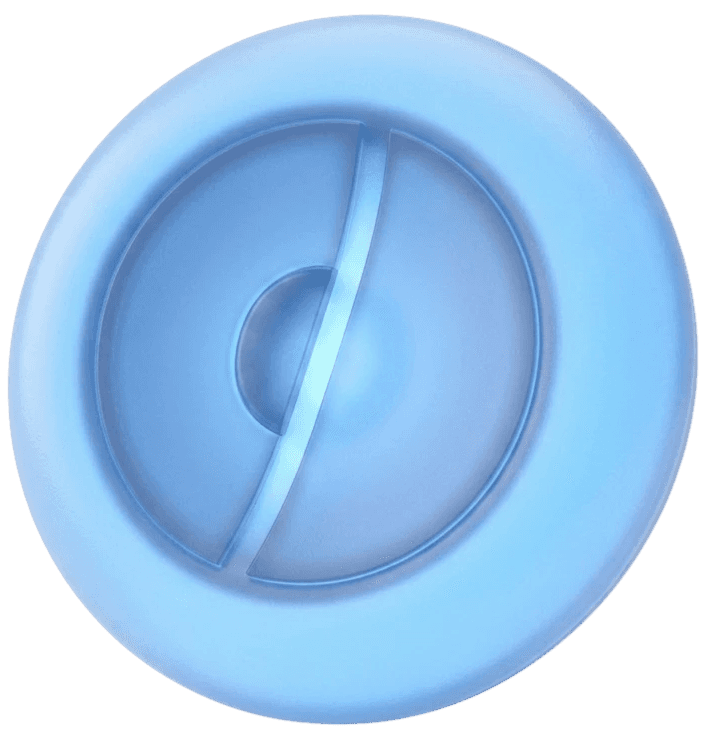
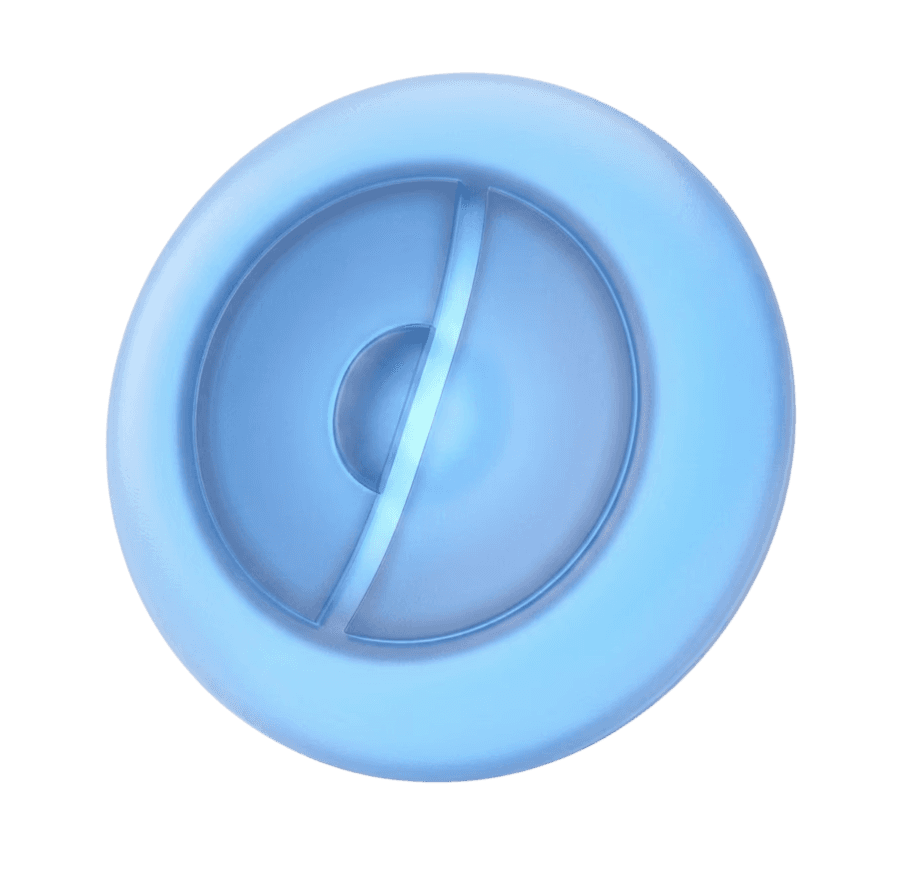
PALM is an assistive communication system designed for individuals living with ALS and their caregivers.
PALM is an assistive communication system designed for individuals living with ALS and their caregivers.
By translating low-effort touch inputs into personalised light and sound patterns,
By translating low-effort touch inputs into personalised light and sound patterns,
it preserves autonomy, dignity, and emotional connection when communication becomes difficult.
it preserves autonomy, dignity, and emotional connection when communication
becomes difficult.
Palm
ROLE
UX Research & Design,
Physical Computing,
Prototyping
DURATION
2025 - 2026
Graduate project
THEMES
Inclusive Design, Assistive
Tech, Physical Computing
THE DESIGN CHALLENGE
ALS rapidly takes away speech, fracturing daily life and isolating patients from those they love. This project explores a low-effort experience designed to bridge this gap, preserving identity and connection without words.
Context
Designing for a reality I lived firsthand:
As the child of a persson living with ALS (PALS), I watched my mother slowly lose her voice.
ALS is a progressive disease that destroys nerve cells, eventually causing paralysis, and speech loss. Witnessing the physical and emotional toll of this disease sparked a deep desire to use my discipline to improve life for those who are non-verbal. This project is both a personal mission and a call to action for designers to take collective responsibility for digital accessibility.
Glossary
PALS
Persons with ALS
An acronym to refer to people with ALS.
Dyad/Dyadic
Dyadic
the interactions between the dyad.
Dyads
two people who
relate to each other.
In this project, I used it to describe the PALS and their caregivers
AAC
Augmentative Alternative Communication
Augmentative tools enhance unclear speech, while
alternative tools replace it
once verbal speech is lost.
Glossary
The Challenge
Why design for ALS Communication?
As our digital landscape shifts toward voice-powered interfaces, individuals
who cannot speak are being quietly left behind.
80 to 95%
of PALS will lose ability to meet daily
communication needs using natural speech.
Without inclusive, non-verbal design solutions, families facing speech loss will continue to be excluded from our increasingly voice-reliant world.
80 to 95%
of PALS will lose ability to meet daily communication needs using
natural speech.
As our digital landscape shifts toward voice-powered interfaces, individuals
who cannot speak are being quietly
left behind.
Without inclusive, non-verbal design solutions, families facing speech loss will continue to be excluded from our increasingly voice-reliant world.
Three compounding problems:
Compounding
Problems:
Through secondary research and academic literature, I identified three systemic pain points
that define this communication crisis.
The Progression Gap
Systems can't keep up
Institutional funding and referrals move at a crawl. By the time support arrives, a PALS's abilities have often changed, rendering tools obsolete and leaving families under-equipped.
Caregiver Strain
The Burden of Mediation
As communication fades, caregivers are forced to guess, anticipate, and speak on behalf of the PALS. Though done out of care, this constant guessing exhausts caregivers and erodes PALS agency.
Usability barrier
The tools exist, but don't get used
From eye-gaze tracking to physical boards, existing AAC devices carry a steep learning curve. When the physical or cognitive effort outweighs the reward, families simply set the technology aside.
The Progression Gap
Systems can't keep up
Diagnosis, referrals, and institutional funding move at a crawl. By the time support arrives, a PALS's abilities may have already changes, rendering the tools obsolete.
This leaves families under-equipped at critical times
Caregiver Strain
The Burden of Mediation
As communication fades, caregivers start to guess, anticipate and speak on behalf of the PALS.
Although done out of care, it quietly erodes the PALS's agency and exhausts caregivers in the process.
Usability barrier
The tools exist, but
don't get used.
From eye-gaze tracking to simple boards, AAC devices carry a steep learning curve and high effort.
When the effort outweighs the reward, families simply set the technology aside.
Research
What makes communication feel worth doing?
To understand why these interventions fail, I ran four research methods in parallel,
examining the problem through both a clinical and a deeply personal lens.

Literature review
Grounding insights in clinical research

Case studies
Mapping the existing product landscape.
Hover over each section to read more

Expert Interviews
Gathering expert insights

Autoethnography
Leveraging lived experience
Who I spoke to
Even an innovative concept fails if effort is too high. It needs to
be low-effort, or it will become an expensive paperweight.
Director of AAC, ALS Association
"
"
Even an innovative concept fails if effort is too high. It needs to be low-effort, or it will become an expensive paperweight.
Director of AAC, ALS Association
"
"
Using AAC requires lots of support from the environment. If it's not condusive, then communication doesn't actually happen.
Speech therapist, SG Enable
Using an AAC device requires a lot of support from the environment. If the surroundings are not condusive, then
communication doesn't actually happen.
"
"
Principal Speech therapist, SG Enable Singapore
"
Direct research with PALS was restricted on ethical grounds. To protect this vulnerable user group, I interviewed clinical experts to understand the lived realities of ALS safely and responsibly.
Director of AAC, ALS Association
Leads a team providing communication for PALS across the US. They provided systemic insights into device usage barriers and critical success factors for interventions.
Director of AAC, ALS Association
Speech Therapist, SG Enable
Principal Speech Therapist, SG Enable
Works directly with a specialist team. They shared insights into the frustrations families face during device adoption and provided access to test existing AAC hardware.
What I looked at
Contextual information
Academic literature covering the baseline nature, physical symptoms, and progressive decline of ALS.
Challenges
Looking at a wide spectrum of ALS, from immediate practical hurdles to long-term emotional, social challenges.
Communication Challenges
Literature covering specific pain points due to the loss of speech and the subsequent communication breakdown.
Case studies
Current interventions, hardware options, and the communication experiences they facilitate.
To ensure clinical viability, I grounded this project in medical literature and case studies. Analysing these sources allowed me to audit existing interventions, identify critical market gaps, and build a medically informed design foundation to validate my ideas.
To ensure clinical viability, I grounded my design in medical literature and case studies. These sources allowed me to audit existing interventions, pinpoint market gaps, and establish a medically informed foundation to inform ideas.
Contextual information
Academic literature covering the nature, physical symptoms, and progressive nature of ALS.
Challenges
Practical daily hurdles alongside long-term emotional and social impacts across the ALS spectrum.
Communication Challenges
Literature covering specific pain points due to the loss of speech and subsequent interaction breakdowns.
Case studies
Current interventions, hardware options, and the communication experiences they facilitate.
What the research kept coming back to:
Four themes emerged consistently across all four research methods:
Time is a critical factor
Community influence success
Infrastructure barriers
Speech loss erodes identity
Click on each theme to view details
These themes revealed that AAC failure isn't a technology problem, but a fit problem.
AAC is failing not because it lacks functionality, but because it lacks emotional and physical usability.
Institutional support struggle to keep up as ALS progresses, leaving families with complex tools that ignore the emotional core of human connection. Ultimately, when a caregiver's comfort dictates a device’s success, the entire system breaks down.
The Joy of Communication
Designing only for the patient meant designing for only half the conversation.
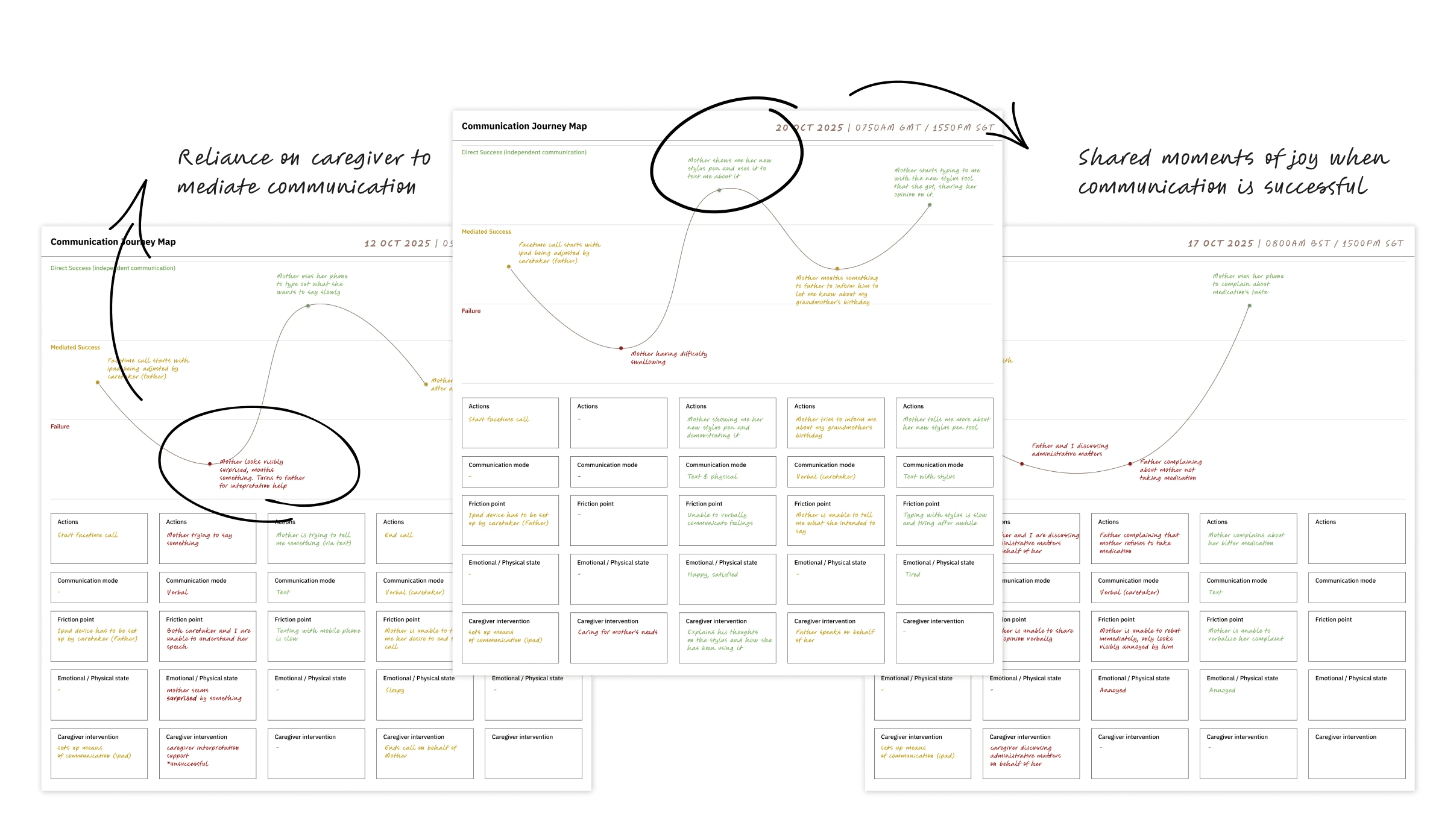
Key Autoethnography observation
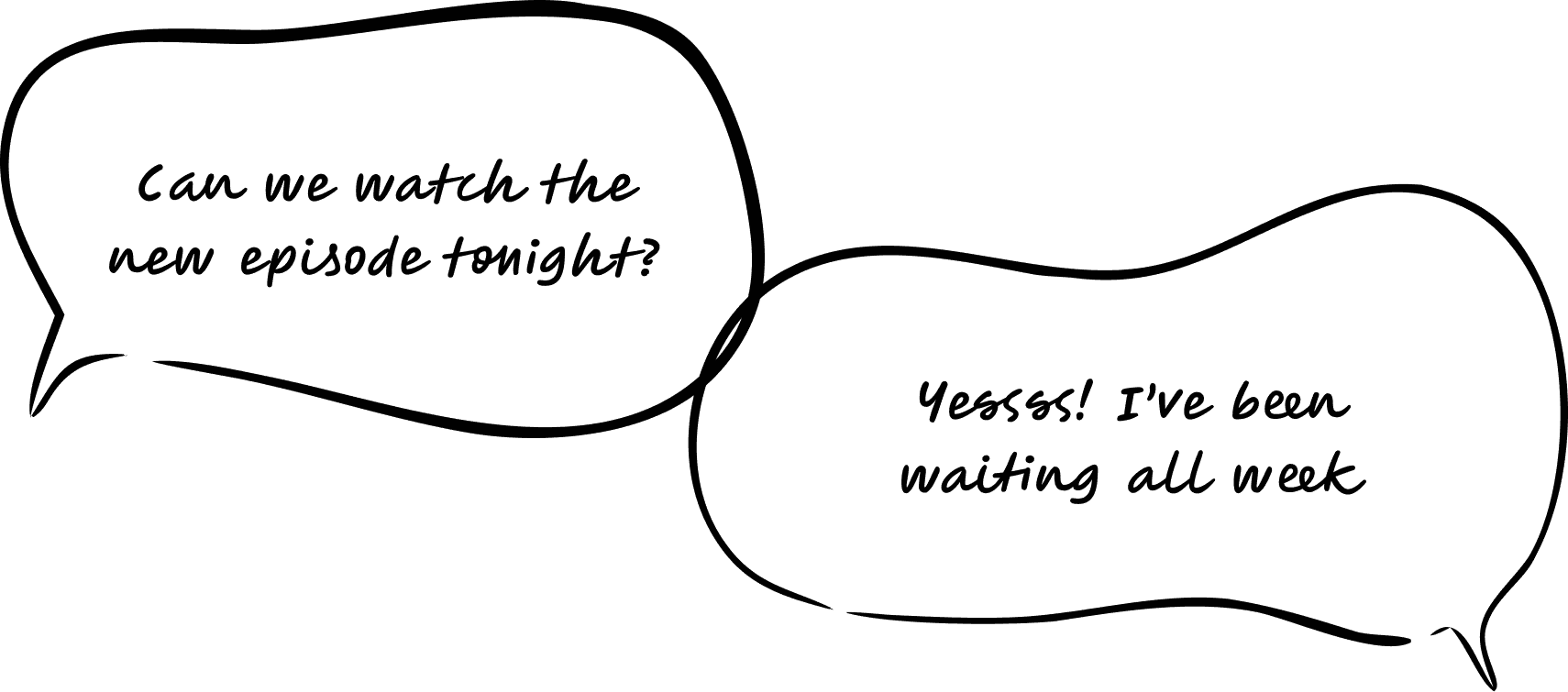
When I used the communication board correctly with my mother, we both laughed. That moment clarified something
That moment clarified something: the goal isn't just effective communication, but also protecting the feeling of being in conversation with someone you love.
When I used the communication board correctly with my mother, we both laughed. That moment clarified something
The goal isn't just effective communication, but protecting the feeling of speaking with your loved one
Key Autoethnography Insight
This centered my focus around the dyad: PALS and caregiver as co-users with equal importance.
Synthesising
From themes to principles
Triangulating findings across all research methods produced a first set of design principles:

Research Theme
Time is a critical factor
Infrastructure barriers
Speech loss erodes identity
Community influence success
Design principle
Center progression and timing
Ensure resilient utility through
low-effort input
Protect identity and agency
through amplified outputs
Design for relational ecosystems

Research Theme
Design principle
Time is always running out
Center progression and timing

Community influence success
Design for relational ecosystems
Infrastructure barriers
Ensure resilient utility through
low-effort input
Speech loss erodes identity
Protect identity and agency
through amplified outputs
All four principles converged on one question:
How might we…
Design a Reliable Communication Solution
for the PALS-Caregiver Dyad,
that preserves emotional agency and connection as abilities change?
Autoethnographic charts
Context
Designing for a reality I lived firsthand:
As the child of a persson living with ALS (PALS), I watched my mother slowly lose her voice.
ALS is a progressive disease that destroys nerve cells, eventually causing paralysis, and speech loss. Witnessing the toll of this disease sparked a deep desire to use my discipline to improve life for those who are non-verbal.
This project is both a personal mission and a call to action for designers to take collective responsibility for digital accessibility.
Glossary
PALS
Persons with ALS
An acronym to refer to people with ALS.
Dyad/Dyadic
Dyadic
the interactions between the dyad.
Dyads
two people who
relate to each other.
In this project, I used it to describe the PALS and their caregivers
AAC
Augmentative Alternative Communication
Augmentative tools enhance unclear speech, while
alternative tools replace it
once verbal speech is lost.
Glossary
The Challenge
Why design
for ALS Communication?
As our digital landscape shifts toward voice-powered interfaces, individuals
who cannot speak are being quietly left behind.
80 to 95%
of PALS will lose ability to meet daily
communication needs using natural speech.
Without inclusive, non-verbal design solutions, families facing speech loss will continue to be excluded from our increasingly voice-reliant world.
80 to 95%
of PALS will lose ability to meet daily communication needs using
natural speech.
As our digital landscape shifts toward voice-powered interfaces, individuals
who cannot speak are being quietly
left behind.
Without inclusive, non-verbal design solutions, families facing speech loss will continue to be excluded from our increasingly voice-reliant world.
Three
Compounding
Problems:
Through secondary research and academic literature, I identified three systemic pain points that define this communication crisis.
The Progression Gap
Systems can't keep up
Institutional funding and referrals move at a crawl. By the time support arrives, a PALS's abilities have often changed, rendering tools obsolete and leaving families under-equipped.
Caregiver Strain
The Burden of Mediation
As communication fades, caregivers are forced to guess, anticipate, and speak on behalf of the PALS. Though done out of care, this constant guessing exhausts caregivers and erodes PALS agency.
Usability barrier
The tools exist, but don't get used
From eye-gaze tracking to physical boards, existing AAC devices carry a steep learning curve. When the physical or cognitive effort outweighs the reward, families simply set the technology aside.
The Progression Gap
Systems can't keep up
Diagnosis, referrals, and institutional funding move at a crawl. By the time support arrives, a PALS's abilities may have already changes, rendering the tools obsolete.
This leaves families under-equipped at critical times
Caregiver Strain
The Burden of Mediation
As communication fades, caregivers start to guess, anticipate and speak on behalf of the PALS.
Although done out of care, it quietly erodes the PALS's agency and exhausts caregivers in the process.
Usability barrier
The tools exist, but
don't get used.
From eye-gaze tracking to simple boards, AAC devices carry a steep learning curve and high effort.
When the effort outweighs the reward, families simply set the technology aside.
Research
What makes communication feel worth doing?
To understand why AAC interventions fail,
I analysed the problem through both a clinical and deeply personal lens.
I looked at clinical literature and case studies, conducted autoethnography research, and interviewed clinical professionals working with PALS.
Literature review
Grounding insights in clinical research
Case studies
Mapping the existing product landscape.
Hover over each section to read more
Expert Interviews
Gathering expert insights
Autoethnography
Leveraging lived experience
Who I spoke to
Even an innovative concept fails if effort is too high. It needs to
be low-effort, or it will become an expensive paperweight.
Director of AAC, ALS Association
"
"
Even an innovative concept fails if effort is too high. It needs to be low-effort, or it will become an expensive paperweight.
Director of AAC, ALS Association
"
"
Using AAC requires lots of support from the environment. If it's not condusive, then communication doesn't actually happen.
Speech therapist, SG Enable
Using an AAC device requires a lot of support from the environment. If the surroundings are not condusive, then
communication doesn't actually happen.
"
"
Principal Speech therapist, SG Enable Singapore
"
*Direct research with PALS was restricted on ethical grounds. I interviewed clinical experts to explore the lived realities of ALS safely and responsibly.
Director of AAC, ALS Association
Leads a team providing communication for PALS across the US. They provided systemic insights into device usage barriers and critical success factors for interventions.
Director of AAC, ALS Association
Speech Therapist, SG Enable
Principal Speech Therapist, SG Enable
Works directly with a specialist team. They shared insights into the frustrations families face during device adoption and provided access to test existing AAC hardware.
What I looked at
Contextual information
Academic literature covering the baseline nature, physical symptoms, and progressive decline of ALS.
Challenges
Looking at a wide spectrum of ALS, from immediate practical hurdles to long-term emotional, social challenges.
Communication Challenges
Literature covering specific pain points due to the loss of speech and the subsequent communication breakdown.
Case studies
Current interventions, hardware options, and the communication experiences they facilitate.
To ensure clinical viability, I grounded this project in medical literature and case studies. Analysing these sources allowed me to audit existing interventions, identify critical market gaps, and build a medically informed design foundation to validate my ideas.
To ensure clinical viability, I grounded my design in medical literature and case studies. These sources allowed me to audit existing interventions, pinpoint market gaps, and establish a medically informed foundation to inform ideas.
Contextual information
Academic literature covering the nature, physical symptoms, and progressive nature of ALS.
Challenges
Practical daily hurdles alongside long-term emotional and social impacts across the ALS spectrum.
Communication Challenges
Literature covering specific pain points due to the loss of speech and subsequent interaction breakdowns.
Case studies
Current interventions, hardware options, and the communication experiences they facilitate.
What the research kept coming
back to:
Four themes emerged consistently across all four research methods:
Time is a critical factor
Community influence success
Infrastructure barriers
Speech loss erodes identity
Click on each theme to view details
These themes revealed that AAC failure isn't a technology problem, but a fit problem.
Existing tools focus heavily on functional utility while ignoring emotional and physical usability. As a result, slow institutional pipelines leave families under-equipped, forcing heavy
mediation onto caregivers.
When a device's success relies entirely
on caregiver endurance, the system inevitably breaks down.
The Joy of Communication
Designing only for the patient meant designing for only half the conversation.
Key Autoethnography observation
When I used the communication board correctly with my mother, we both laughed. That moment clarified something
That moment clarified something: the goal isn't just effective communication, but also protecting the feeling of being in conversation with someone you love.
When I used the communication board correctly with my mother, we both laughed. That moment clarified something
The goal isn't just effective communication, but protecting the feeling of speaking with your loved one
Key Autoethnography Insight
This centered my focus around the dyad: PALS and caregiver as co-users with equal importance.
Synthesising
From themes to principles
Triangulating findings across all four research methods produced a first
set of design principles:
Research Theme
Time is a critical factor
Infrastructure barriers
Speech loss erodes identity
Community influence success
Design principle
Center progression and timing
Ensure resilient utility through
low-effort input
Protect identity and agency
through amplified outputs
Design for relational ecosystems
Research Theme
Design principle
Time is always running out
Center progression and timing
Community influence success
Design for relational ecosystems
Infrastructure barriers
Ensure resilient utility through
low-effort input
Speech loss erodes identity
Protect identity and agency
through amplified outputs
All four principles converged on one question:
How might we…
Design a Reliable Communication Solution for the PALS-Caregiver Dyad,
that preserves emotional agency and connection as abilities change?
Autoethnographic charts
Experimenting
Exploring and Disrupting
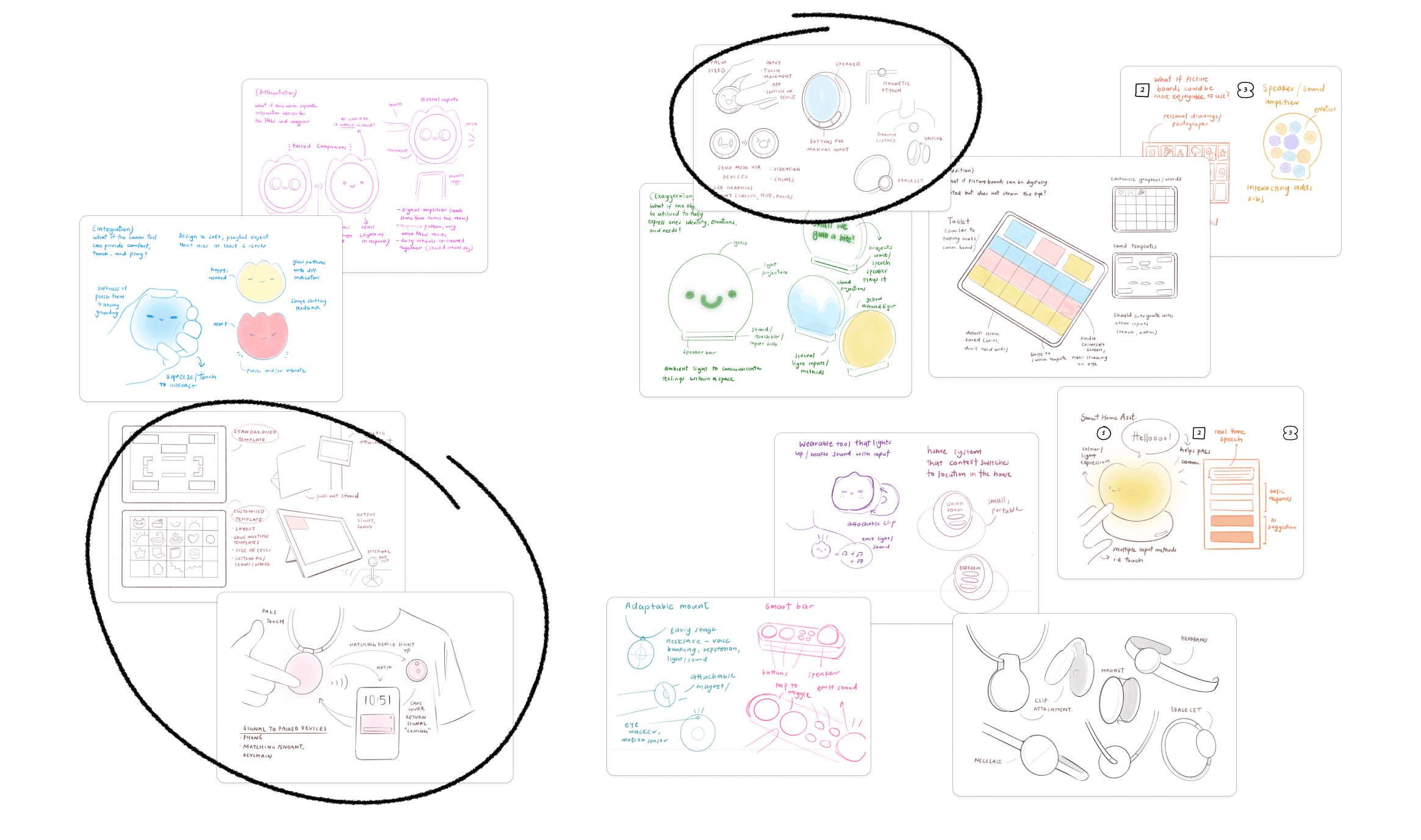
With each concept, I explored ways to communicate beyind speech only mediums, towards light, haptic, and multimodal concepts. The process was deliberately set up to challenge assumptions, moving exploration past what was already known to work toward what hadn't been tried yet.
Design for relational ecosystems
Ensure resilient utility
Protect identity and agency
Design for relational ecosystems
Ensure resilient utility
Protect identity and agency

Rapid ideation generated a broad spectrum of ideas, which I then deconstructed by challenging assumptions, detailing use cases, and defining target users. To push these ideas beyond familiar territory, I used structured ideation prompts to force lateral thinking, sparking a second ambitious round of ideation.
The financial demands of modern life have made dual-income households increasingly common. While this provides greater financial security, it can also lead to time constraints that affect the quality of parent-child relationships.
Testing and refinement
Choosing a direction
Two directions made it through ideation: the Electronic Communication Board and the Wearable.
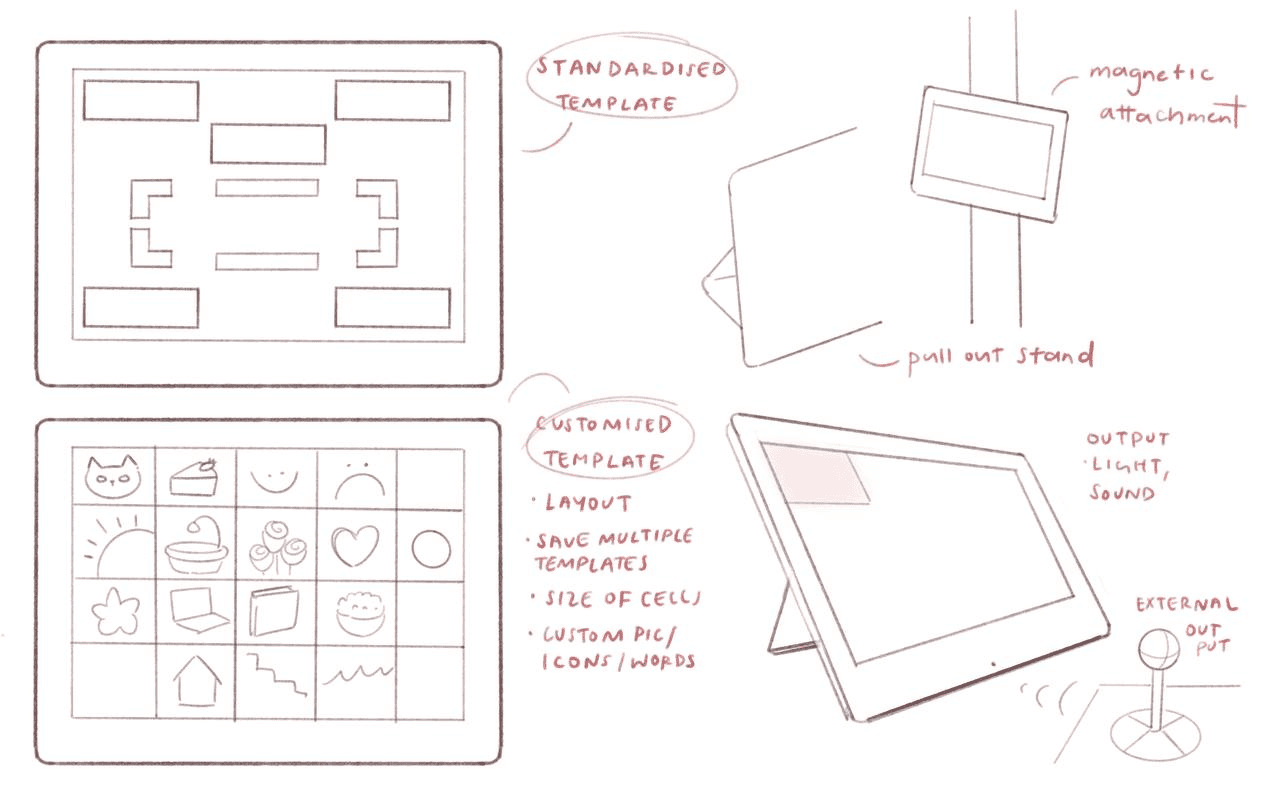
Electronic Communication Board
Electronic Communication Board
E-ink communication boards with
customisable layouts and vocabulary
E-ink communication boards with
customisable layouts and vocabulary
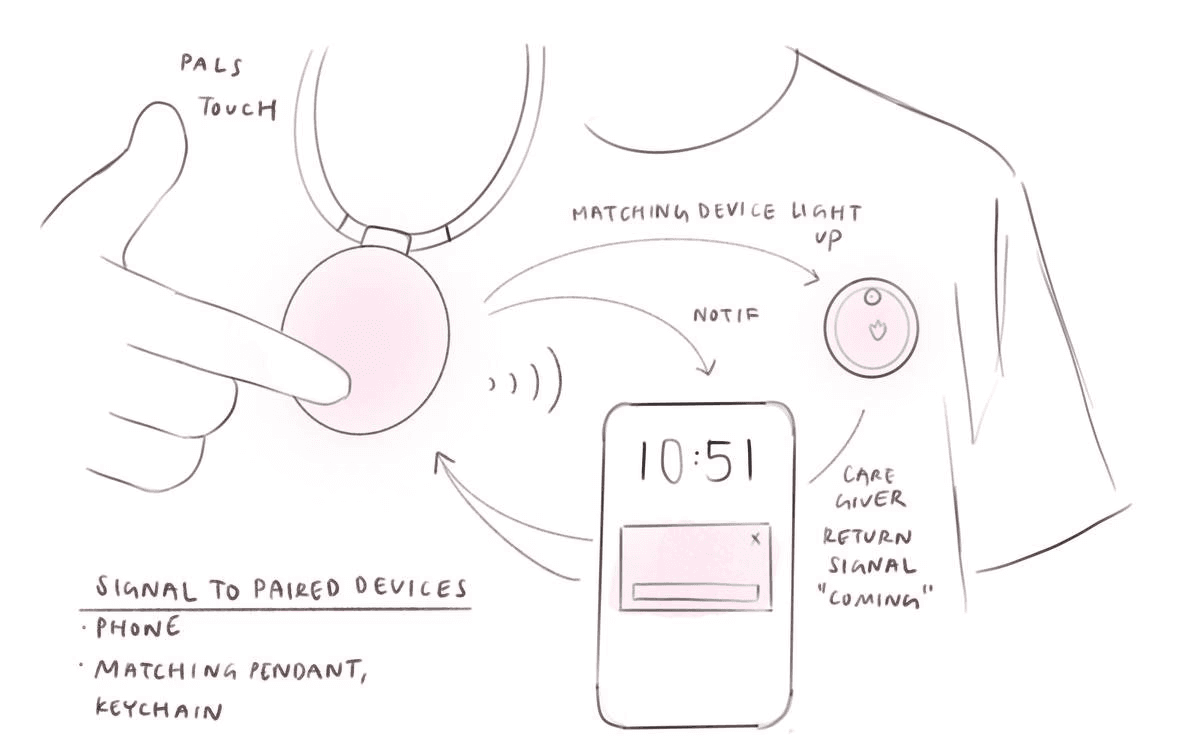
Wearable Communicators
Connected wearable ecosystem that sends
messages from wearable to phone
Connected ecosystem that sends messages from wearable to phone
Testing
User testing and bodystorming quickly revealed that the communication board's bulk and opacity weren't surface-level usability issues that could be iterated away, but were foundational flaws of the physical format.
Not wanting to abandon the concept's most compelling feature: its customizable vocabulary, I integrated it into the wearable's low-effort interaction model.
User testing and bodystorming quickly revealed that the communication board's bulk and opacity weren't surface-level usability issues that could be iterated away, but were foundational flaws of the physical format.
Not wanting to abandon the concept's most compelling feature:
its customizable vocabulary, I integrated it into the wearable's
low-effort interaction model.
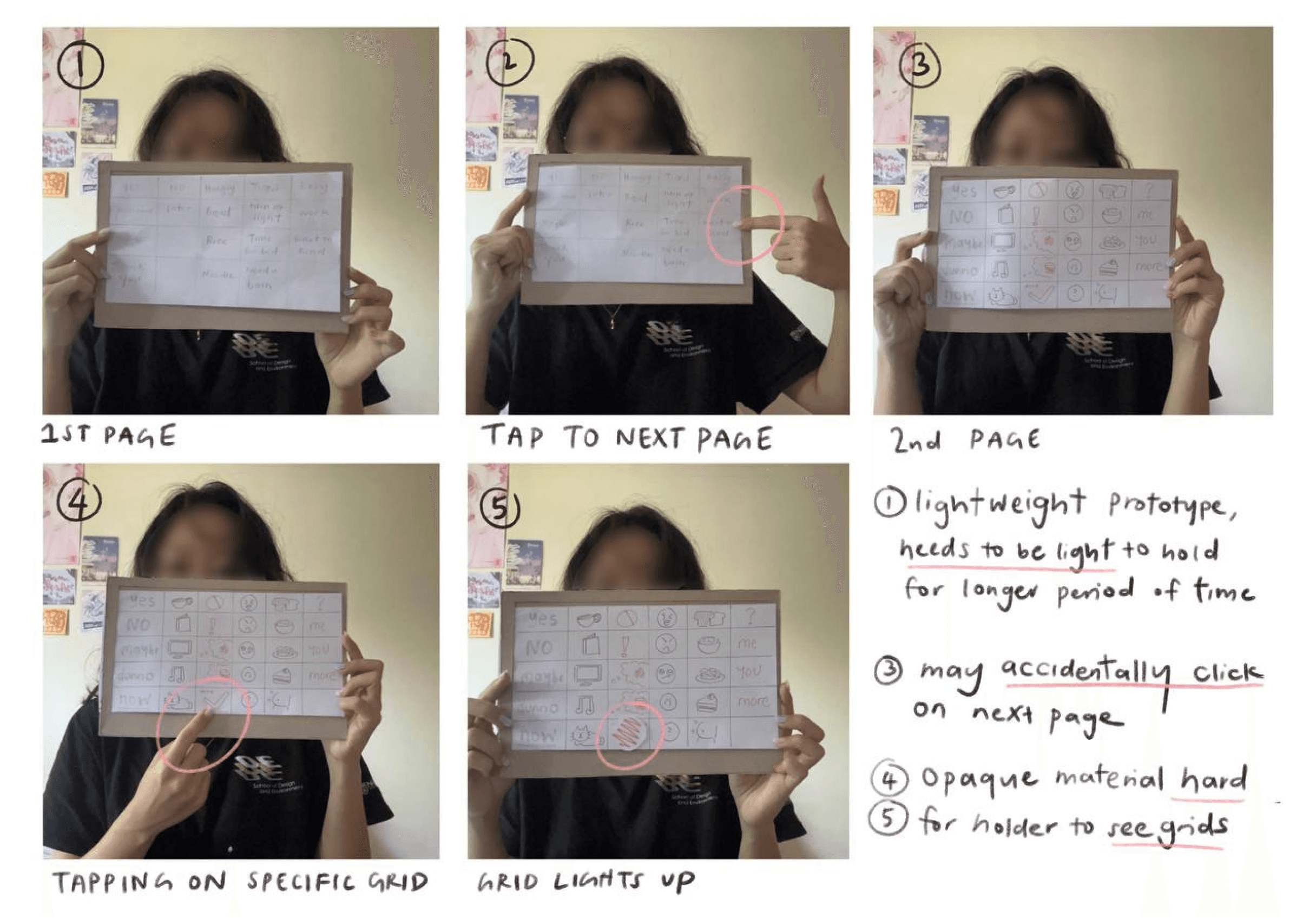
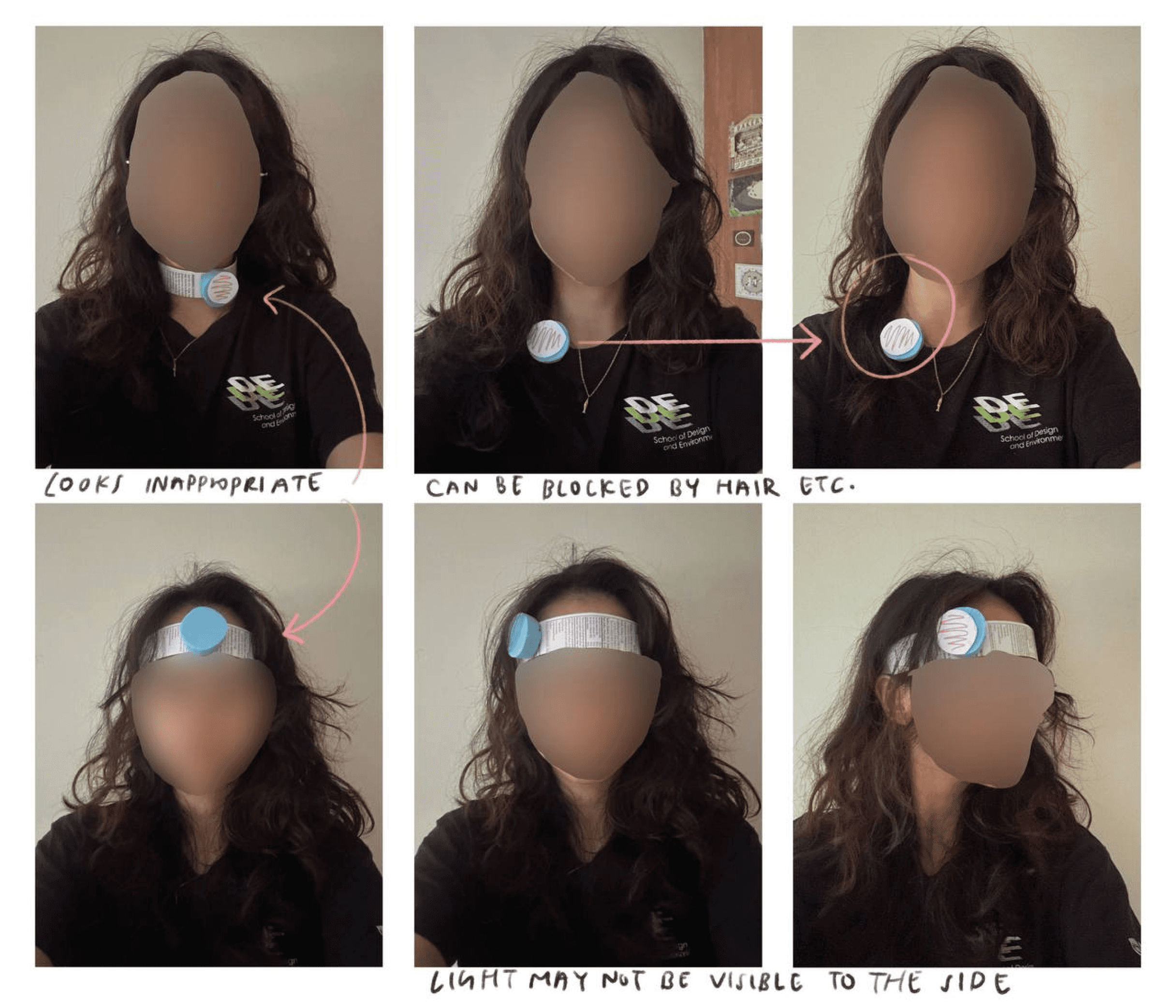
Bodystorming with lo-fi prototypes
Refining
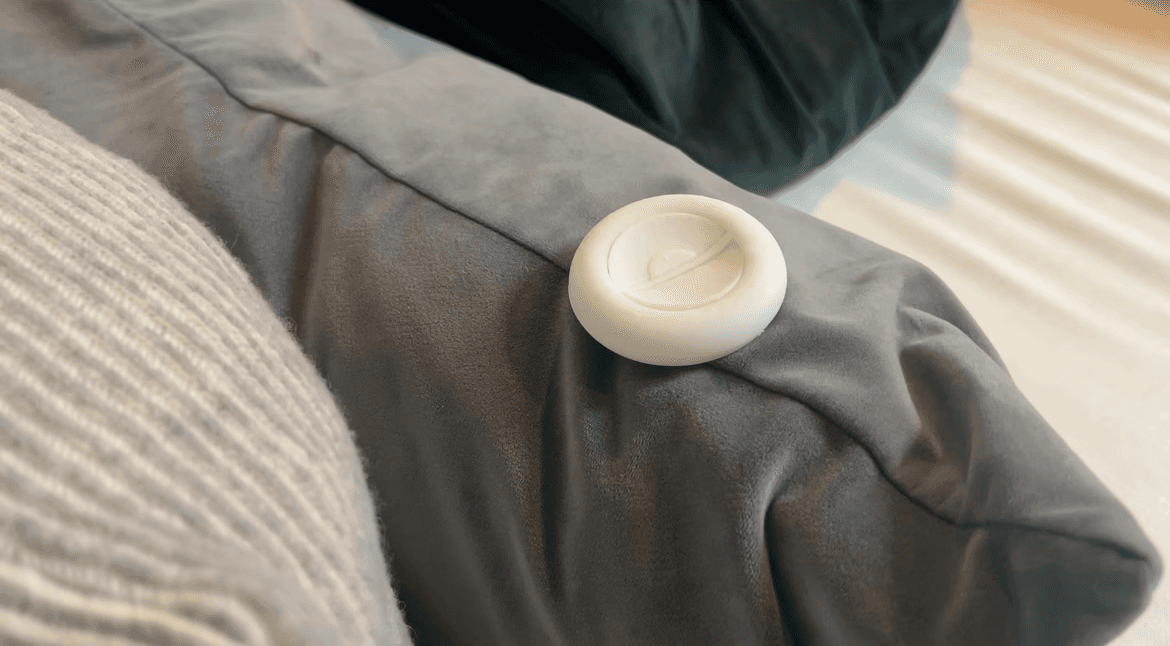
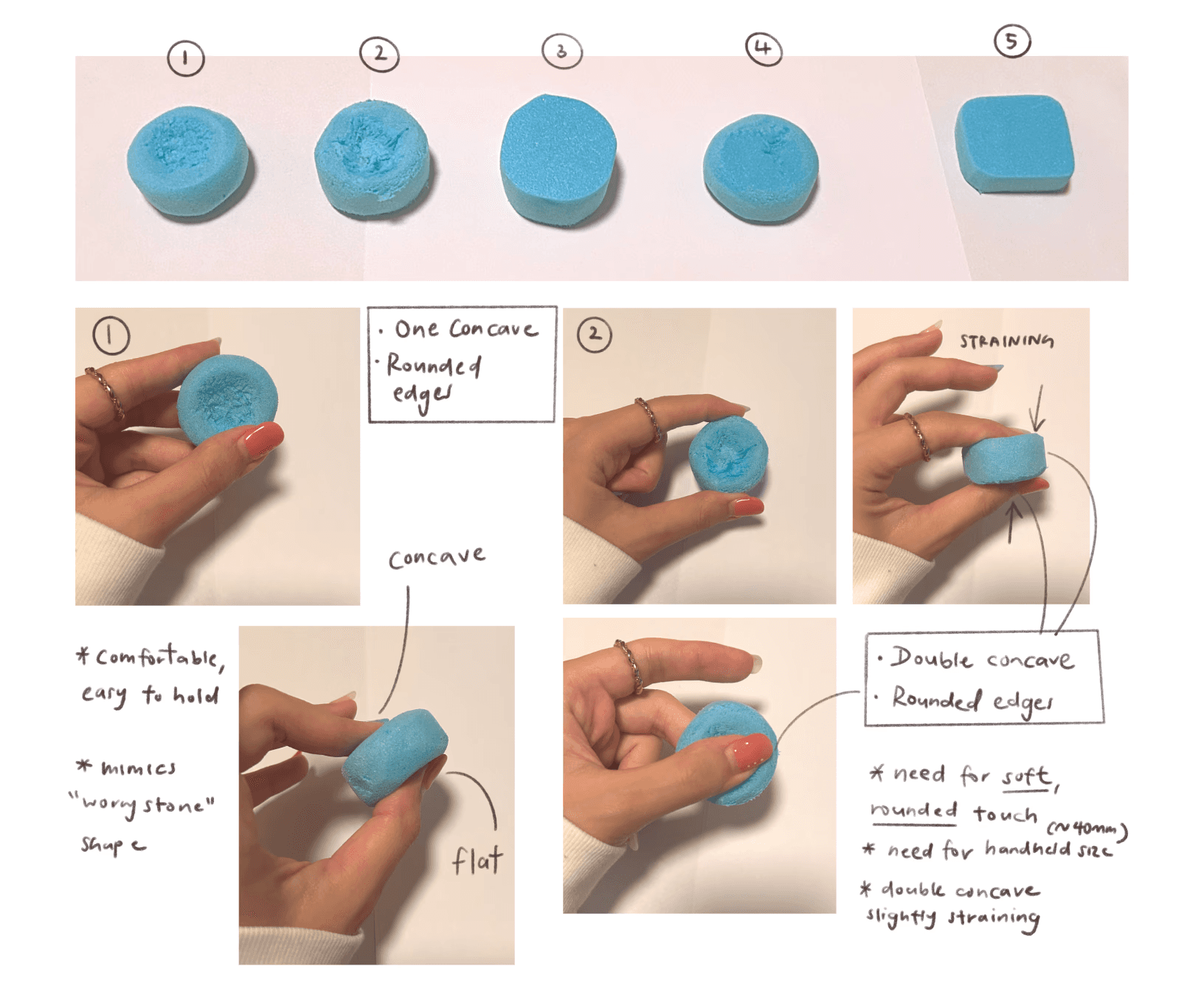
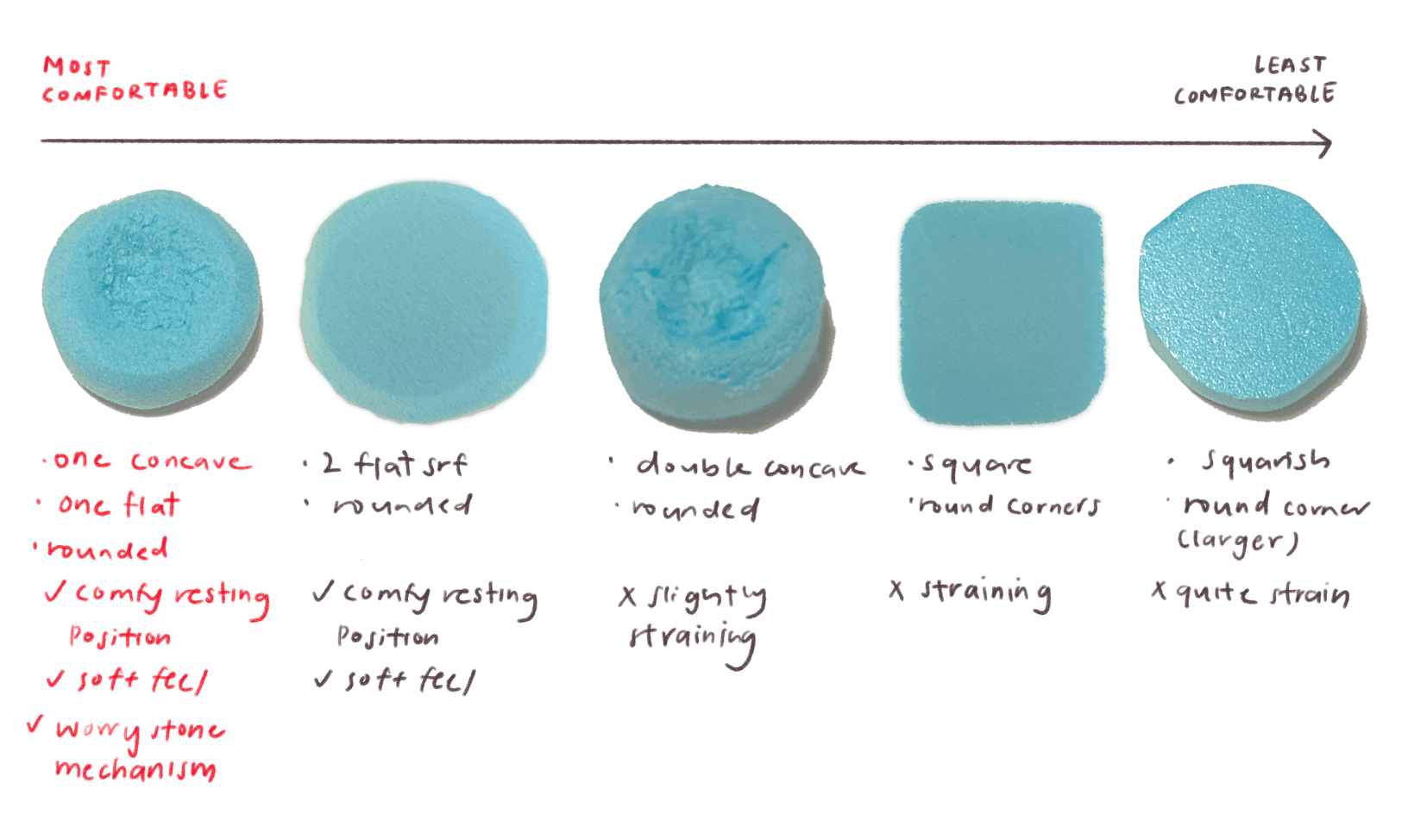
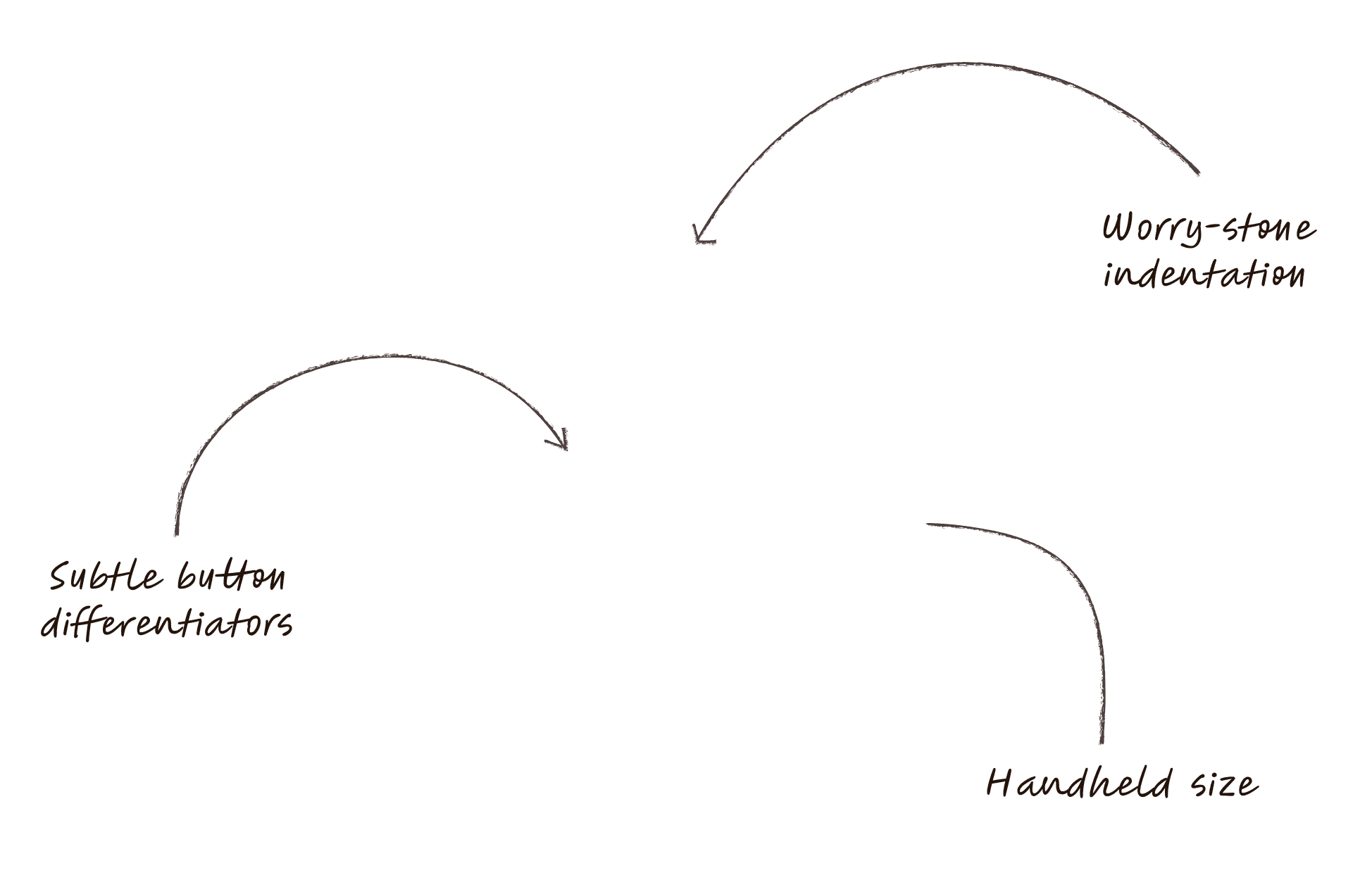
As the device is meant to be touched and held throughout the day, form is the usability problem. Five foam models later, the geometry felt right — rounded edges, a concave thumb indentation, a flat base for stability. It sat naturally in the hand without looking clinical.
As the device is meant to be touched and held throughout the day, form is the usability problem. Five foam models later, the geometry felt right
— rounded edges, a concave thumb indentation, a flat base for stability. It sat naturally in the hand without looking clinical.
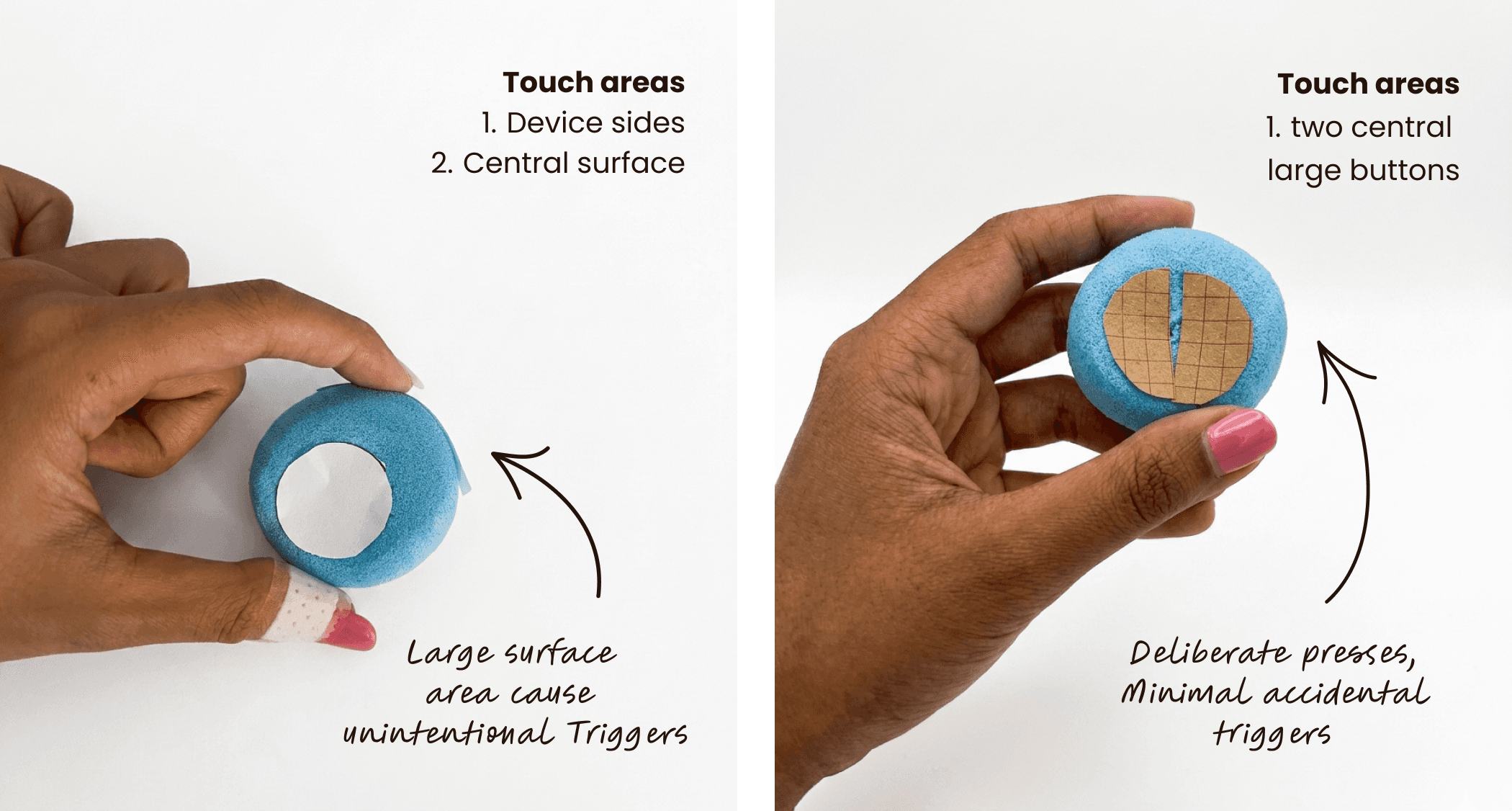
Then testing broke an assumption I hadn't examined: that touch-sensing would feel intuitive.
Natural grip kept triggering accidental inputs. For someone with ALS, a signal sent by mistake isn't just a small inconvenience, it compounds into eroded trust.
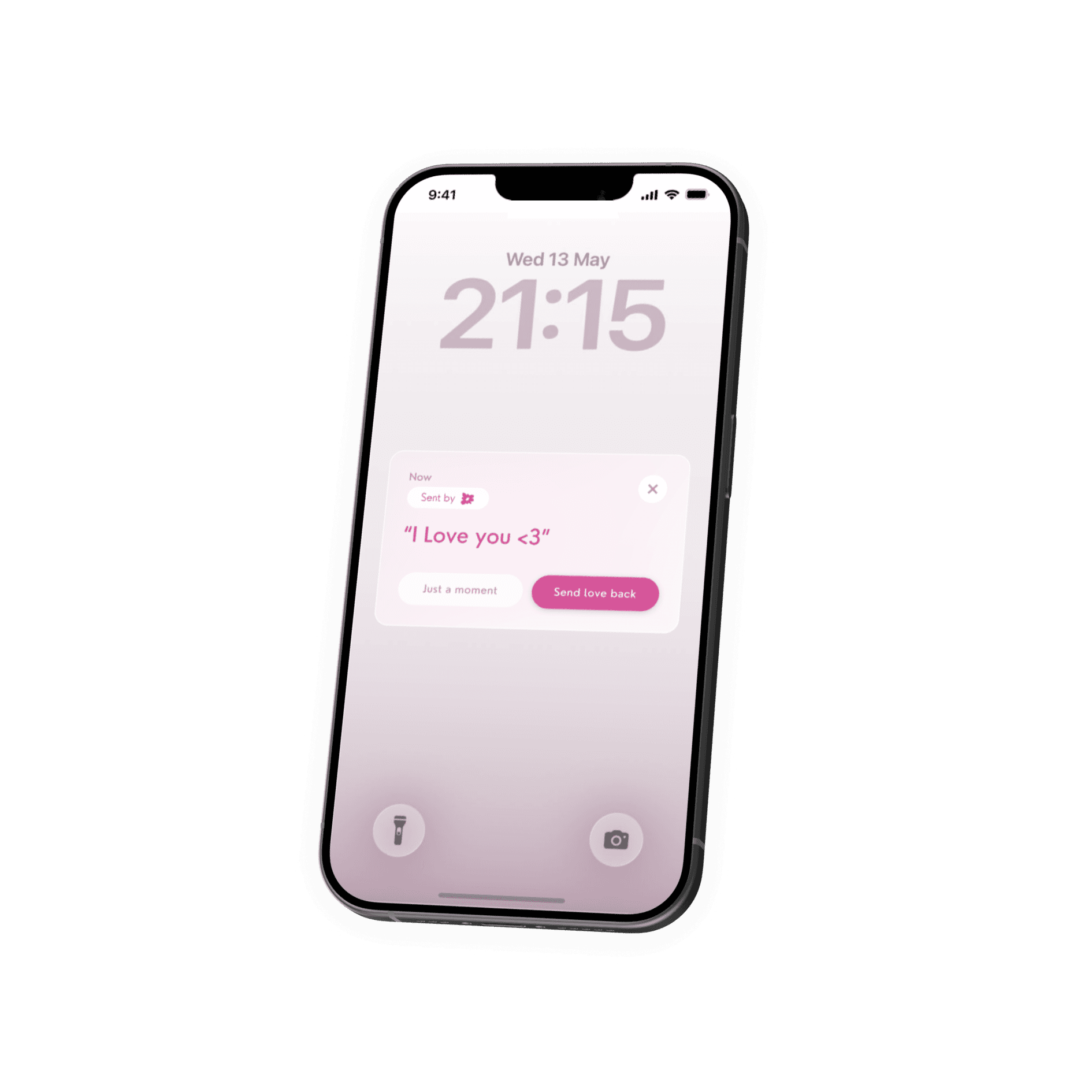
Hence, capacitive touch input turned into mechanical buttons

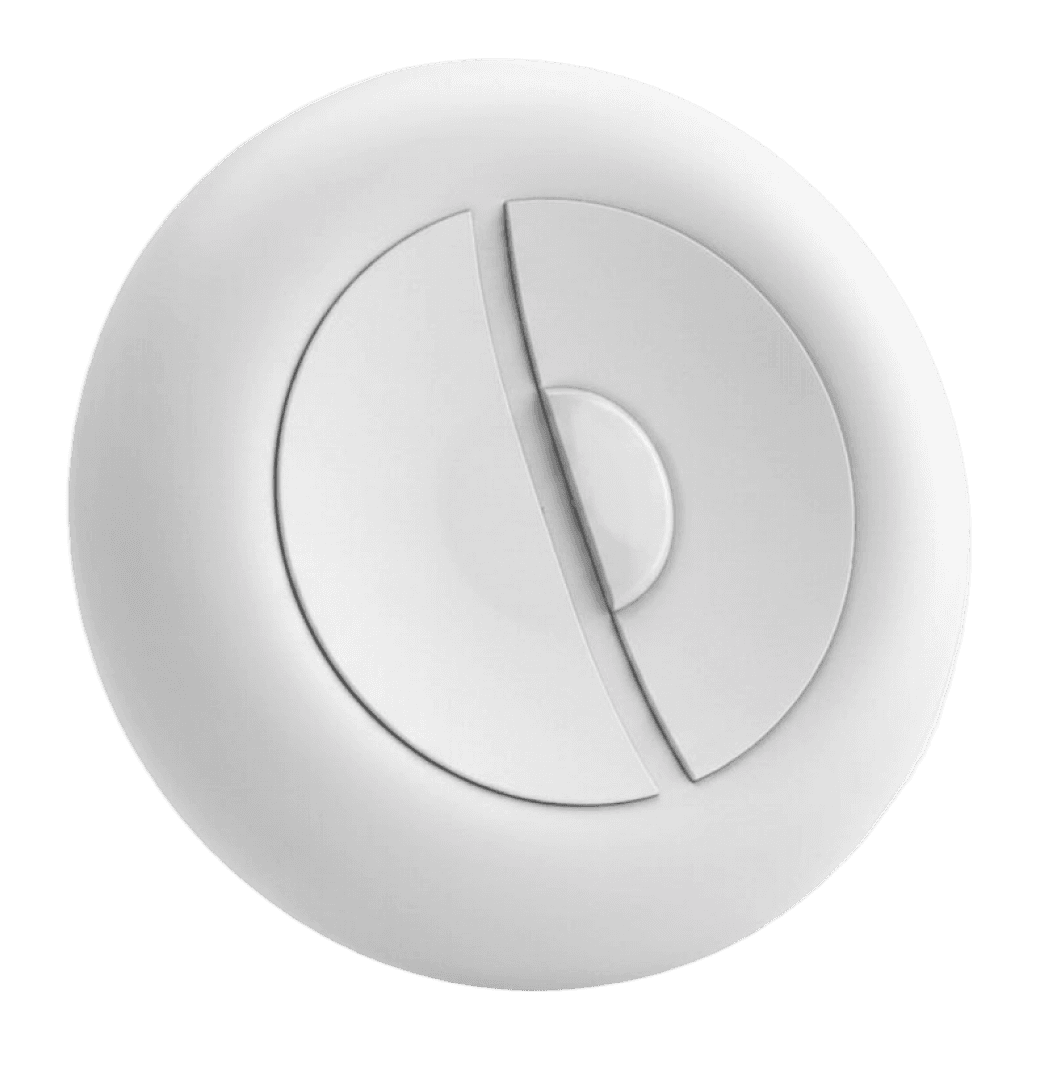
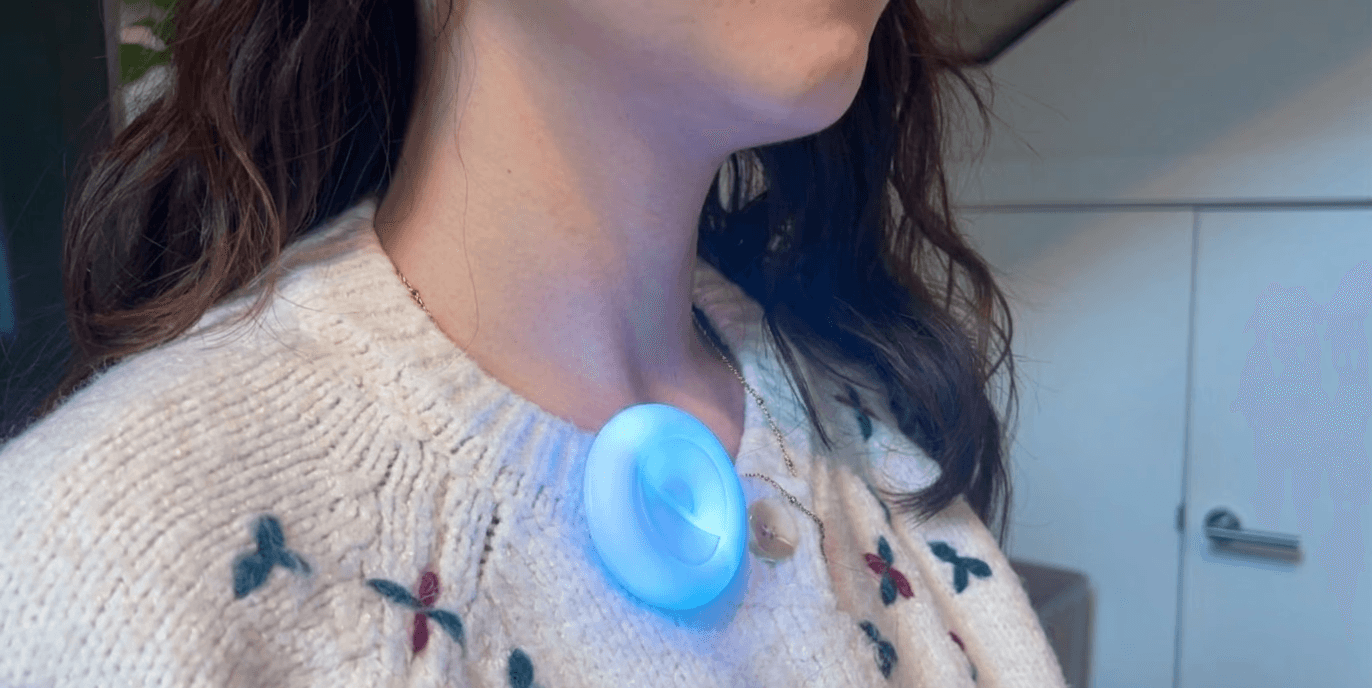
PALM
Presence and light messenger
Wearables designed to keep PALS and their caregivers connected. By translating touch into personalised light and sound, PALM amplifies messages to preserve autonomy and identity.
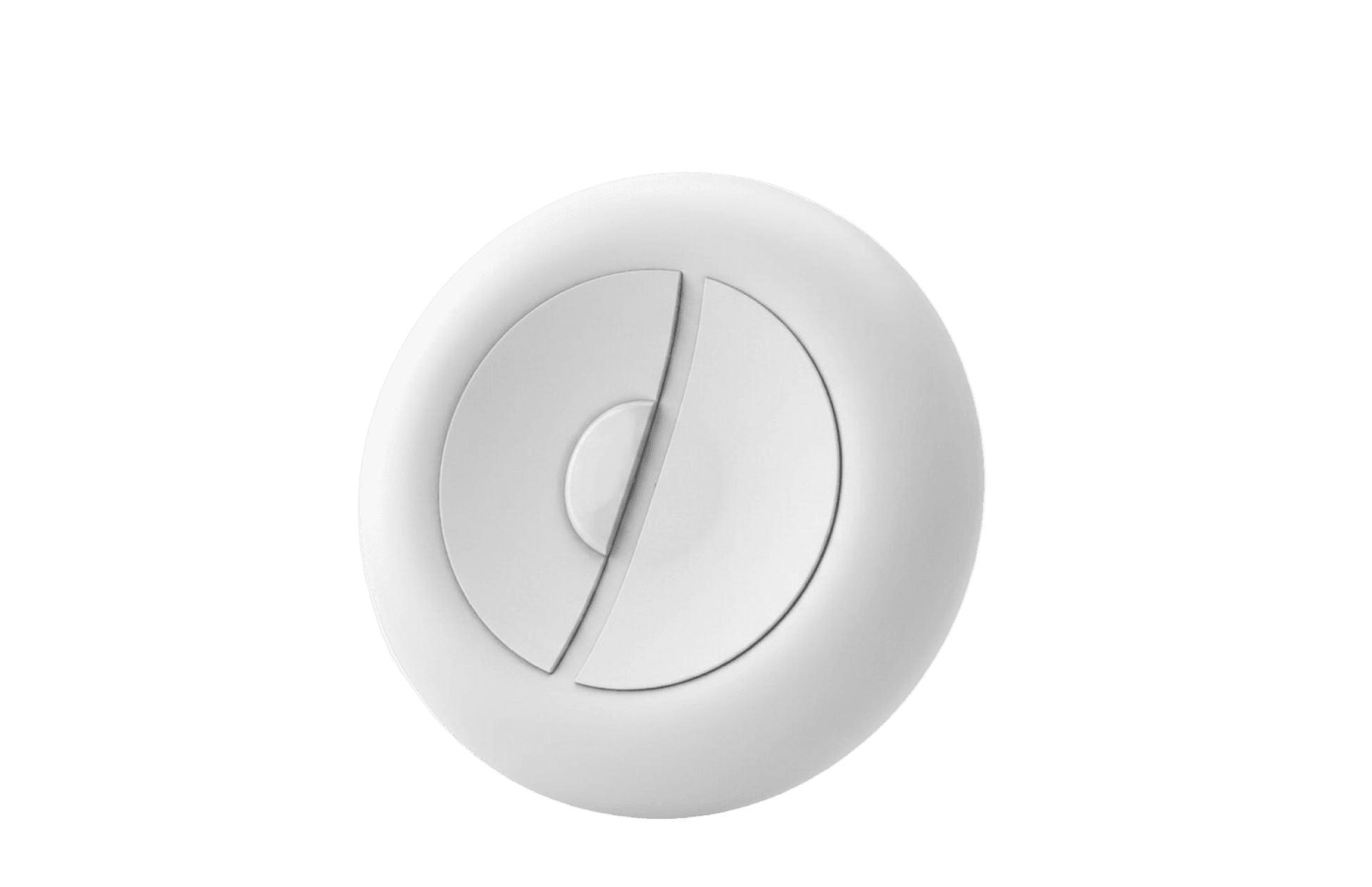
PALM
Presence and light messenger
Wearables designed to keep PALS and their caregivers connected. By translating touch into personalised light and sound, PALM amplifies messages to preserve
autonomy and identity.
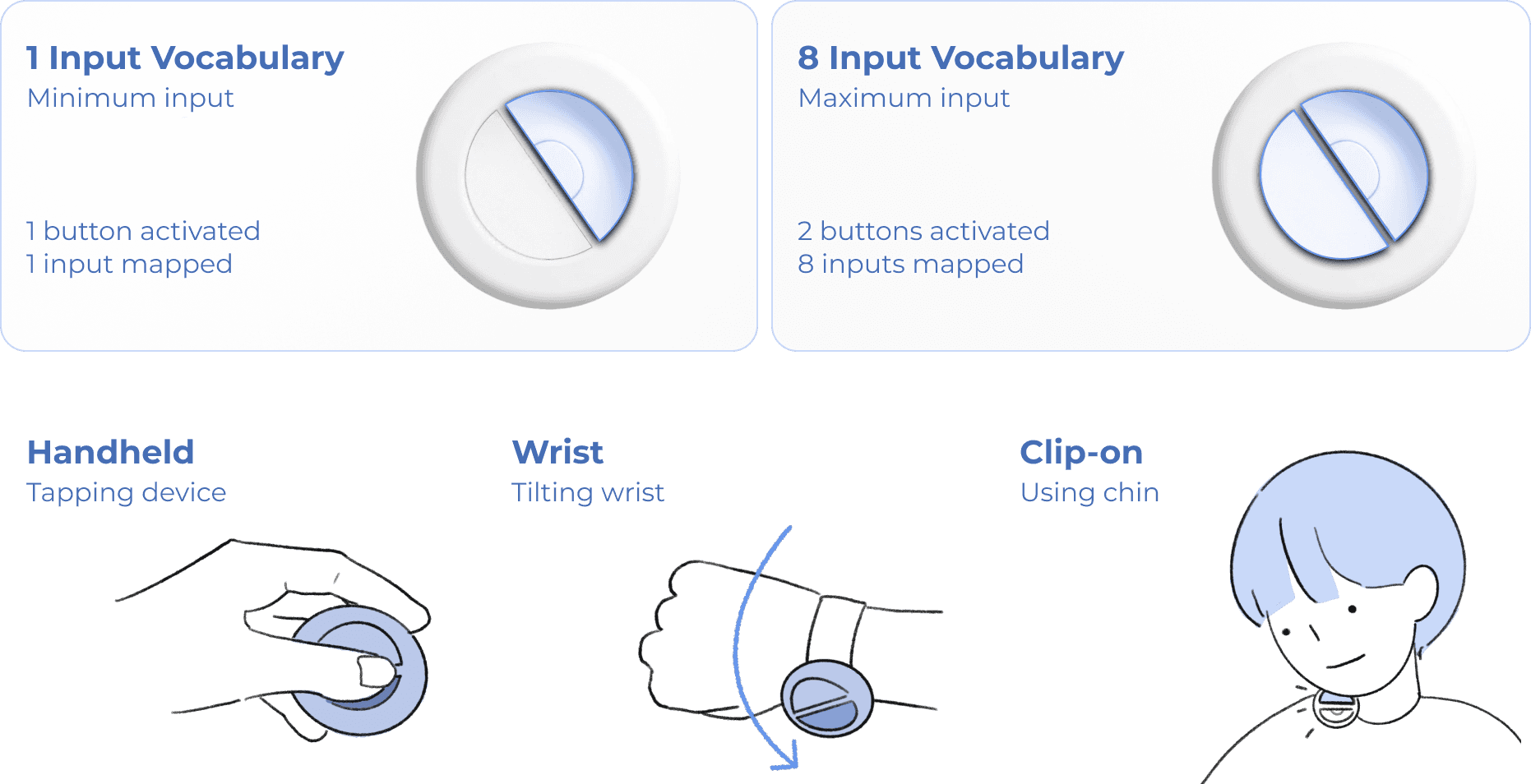
Input that scales with the user
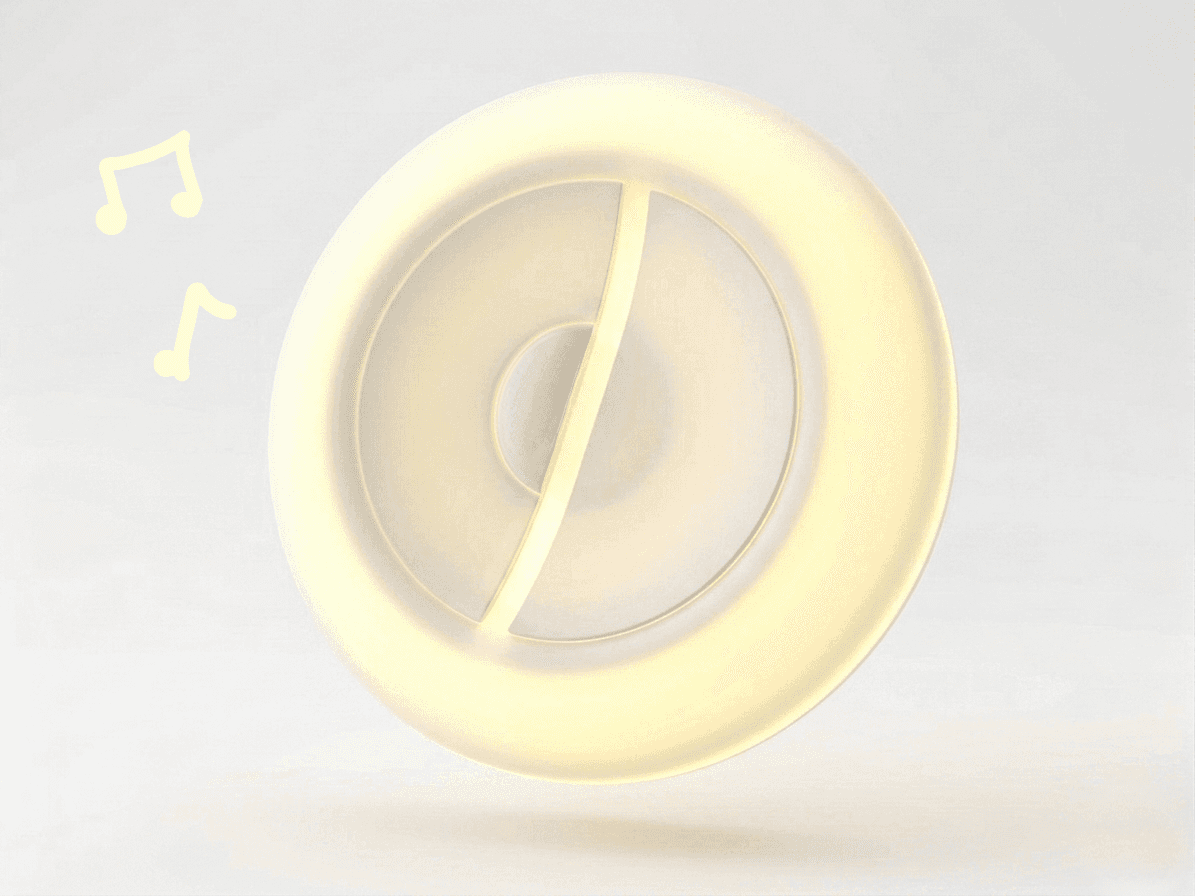
Up to eight messages mapped across four press types. As motor skills decline, the vocabulary scales down to a single press on the same device, requiring zero relearning. The form factor versatilely adapts to handheld, wrist, or clip-on placement.
Designed to be held
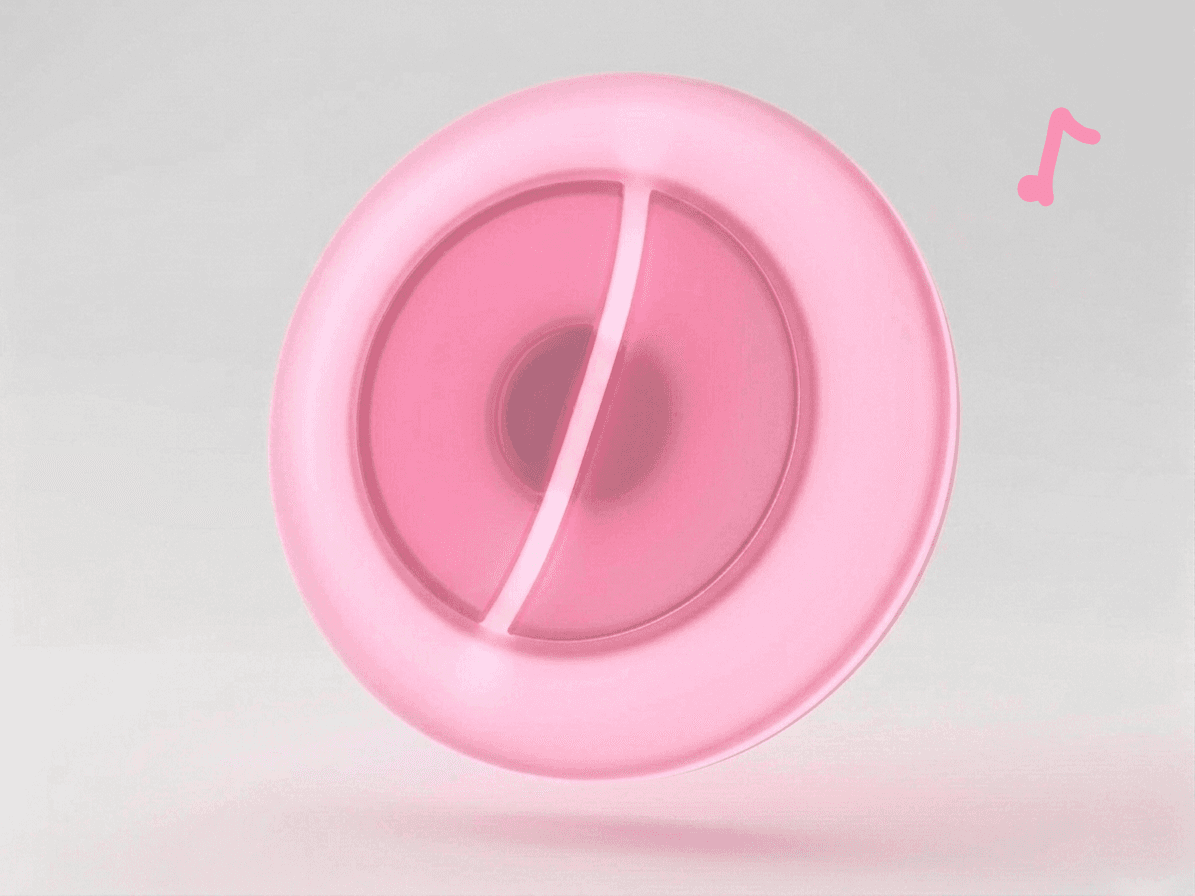
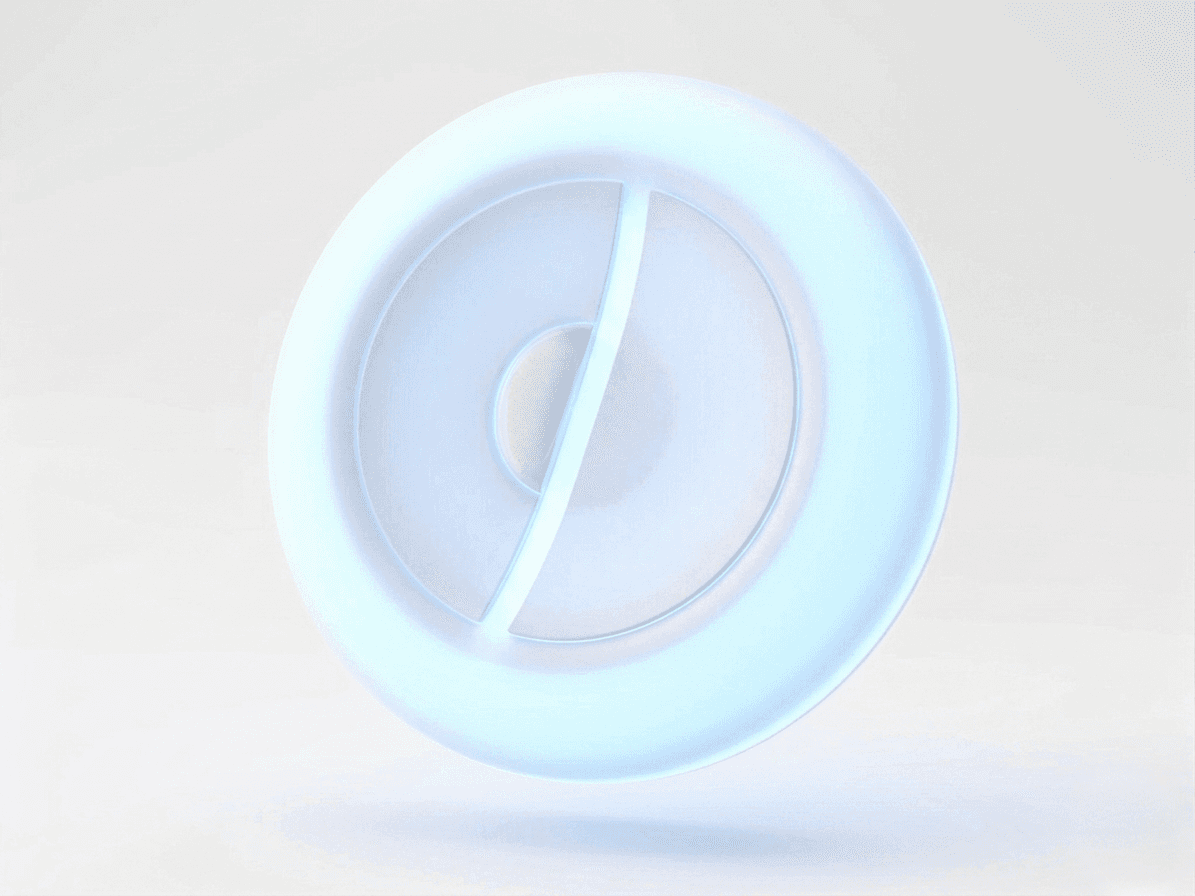
The device features a concave thumb pocket and two oversized buttons distinguishable by touch alone. An adaptive hold-time buffer filters out tremors, ensuring only deliberate presses trigger a signal.

Amplified outputs
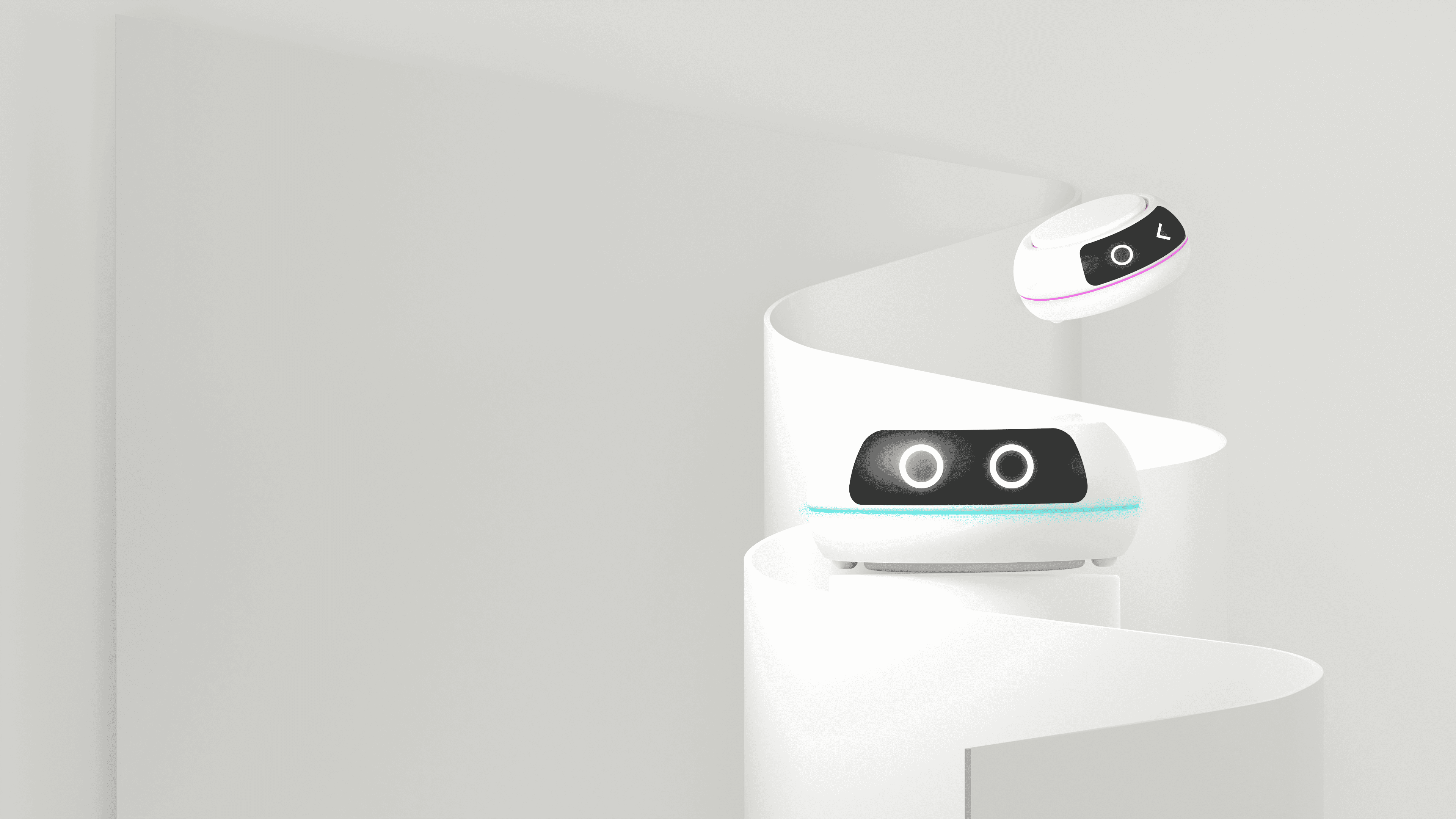
Each message carries a colour, pulse, and tone chosen by the PALS and caregiver — gratitude, annoyance, affection each feel distinct.
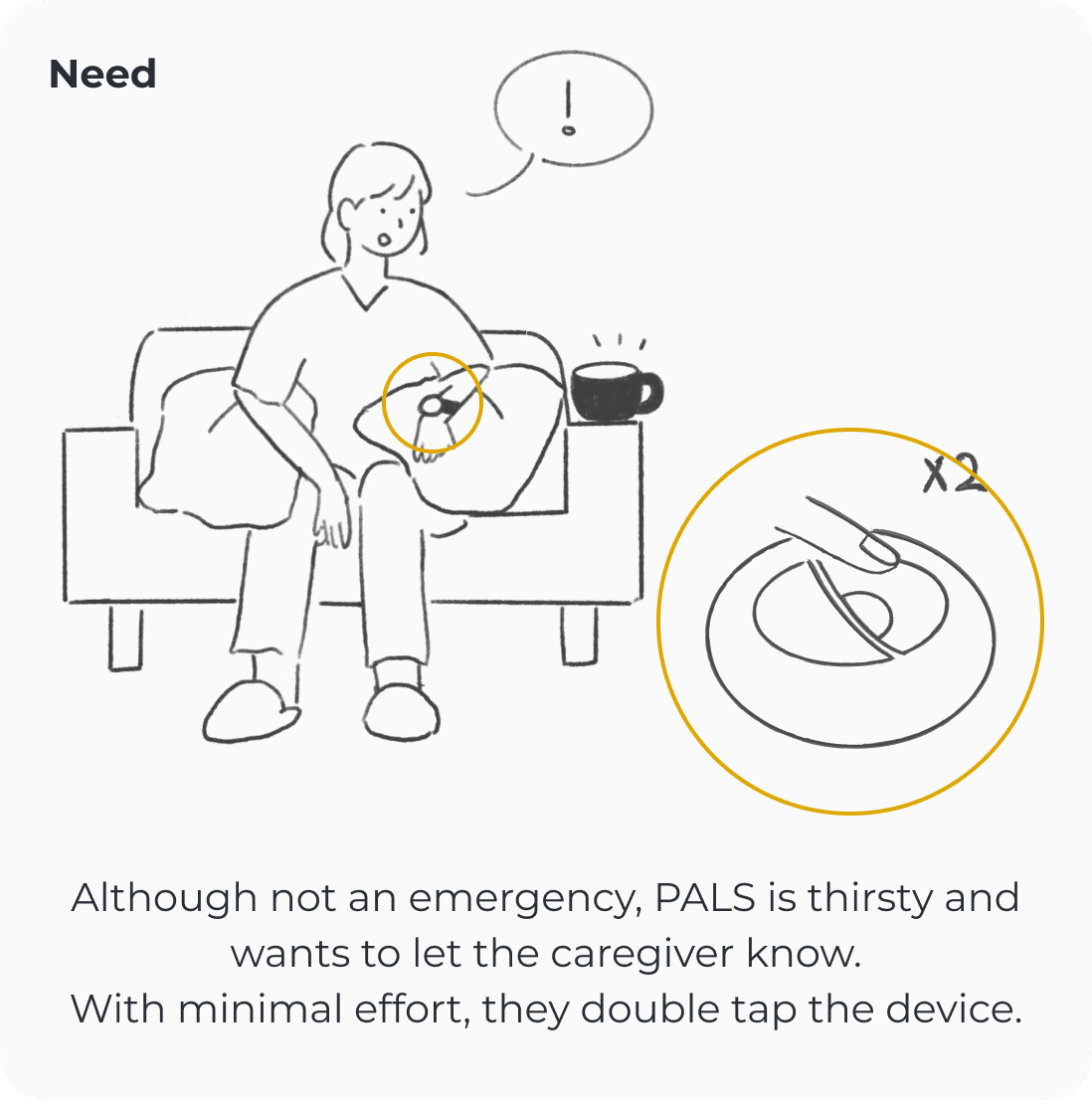
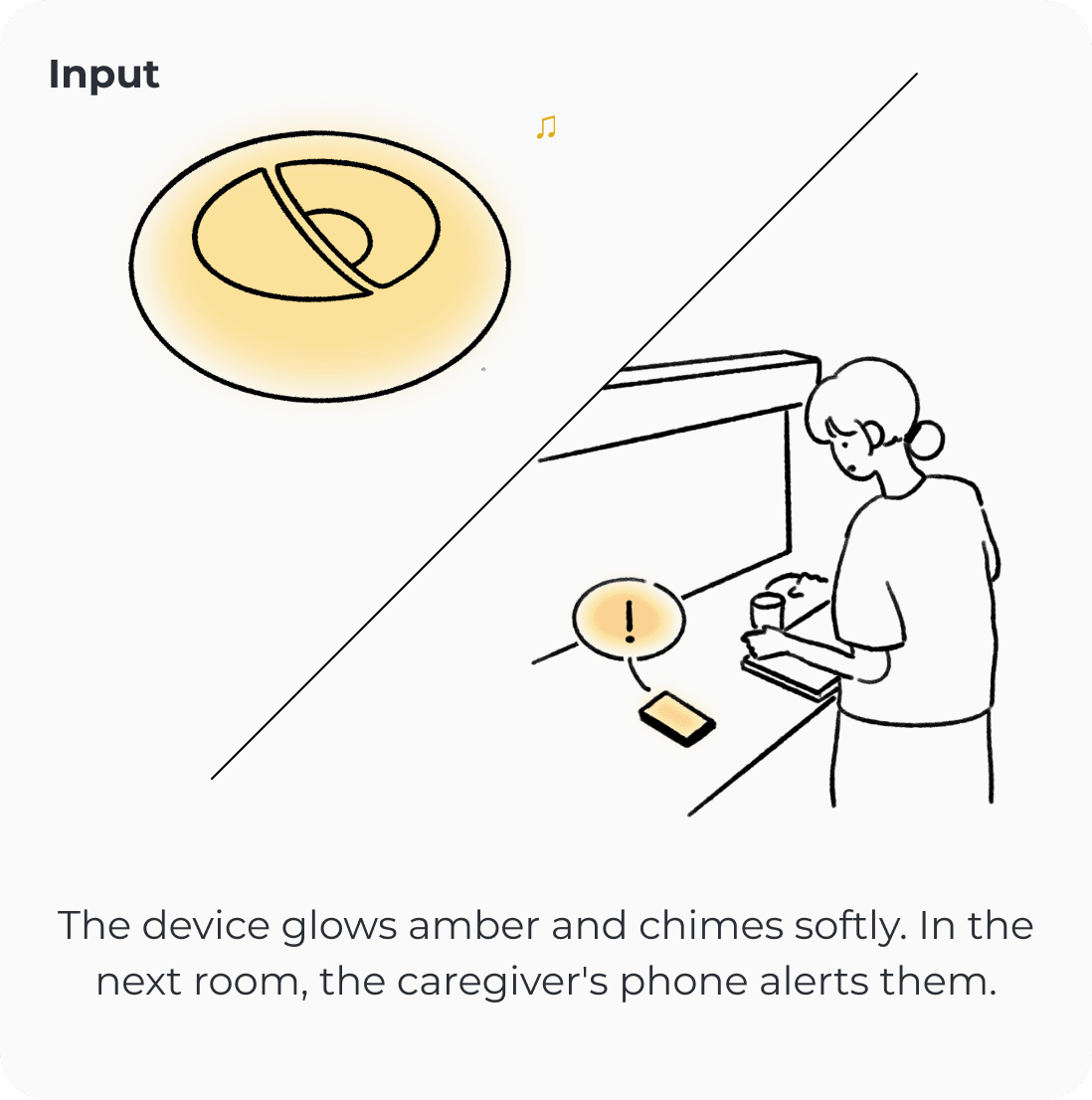
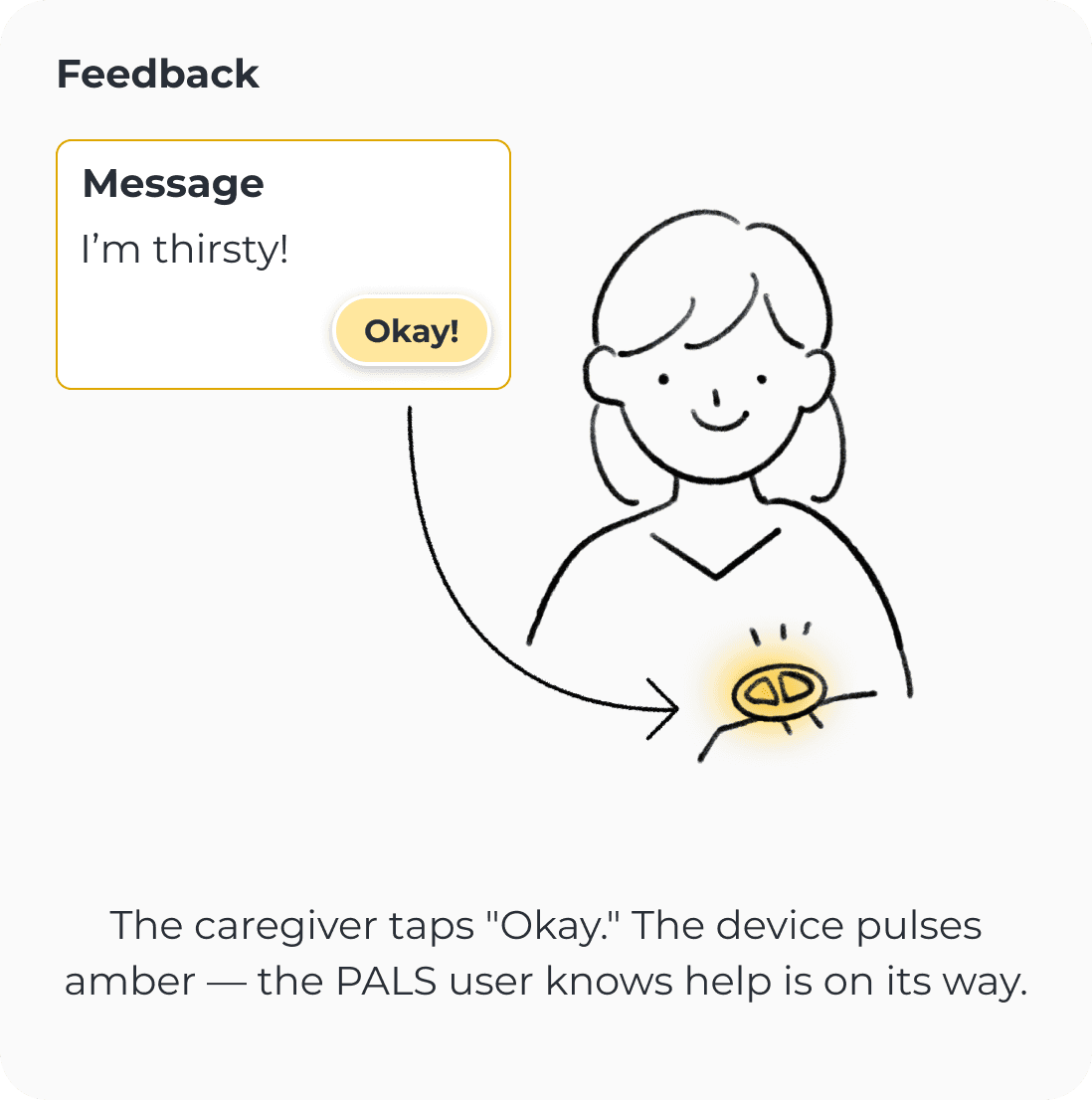
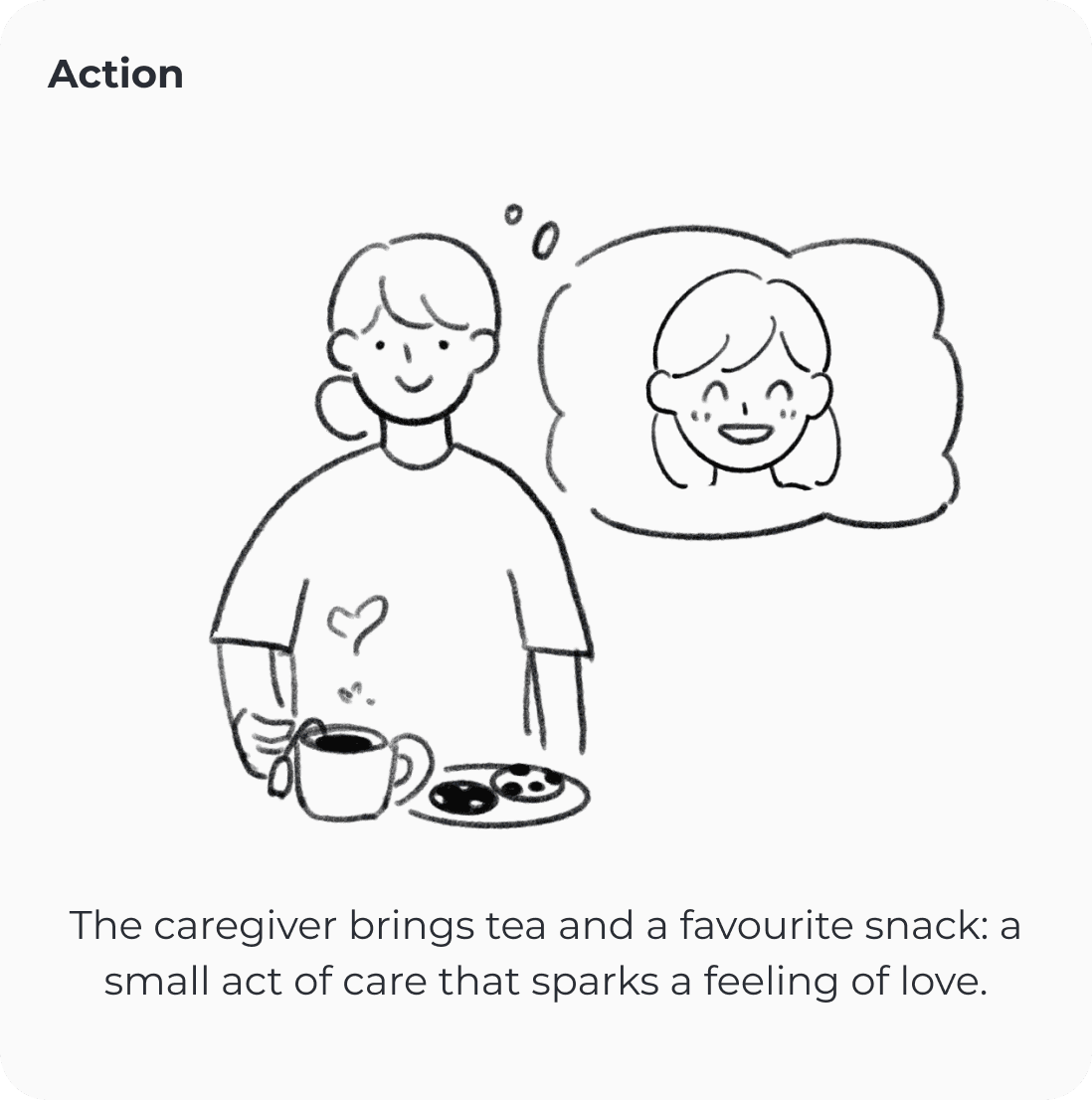
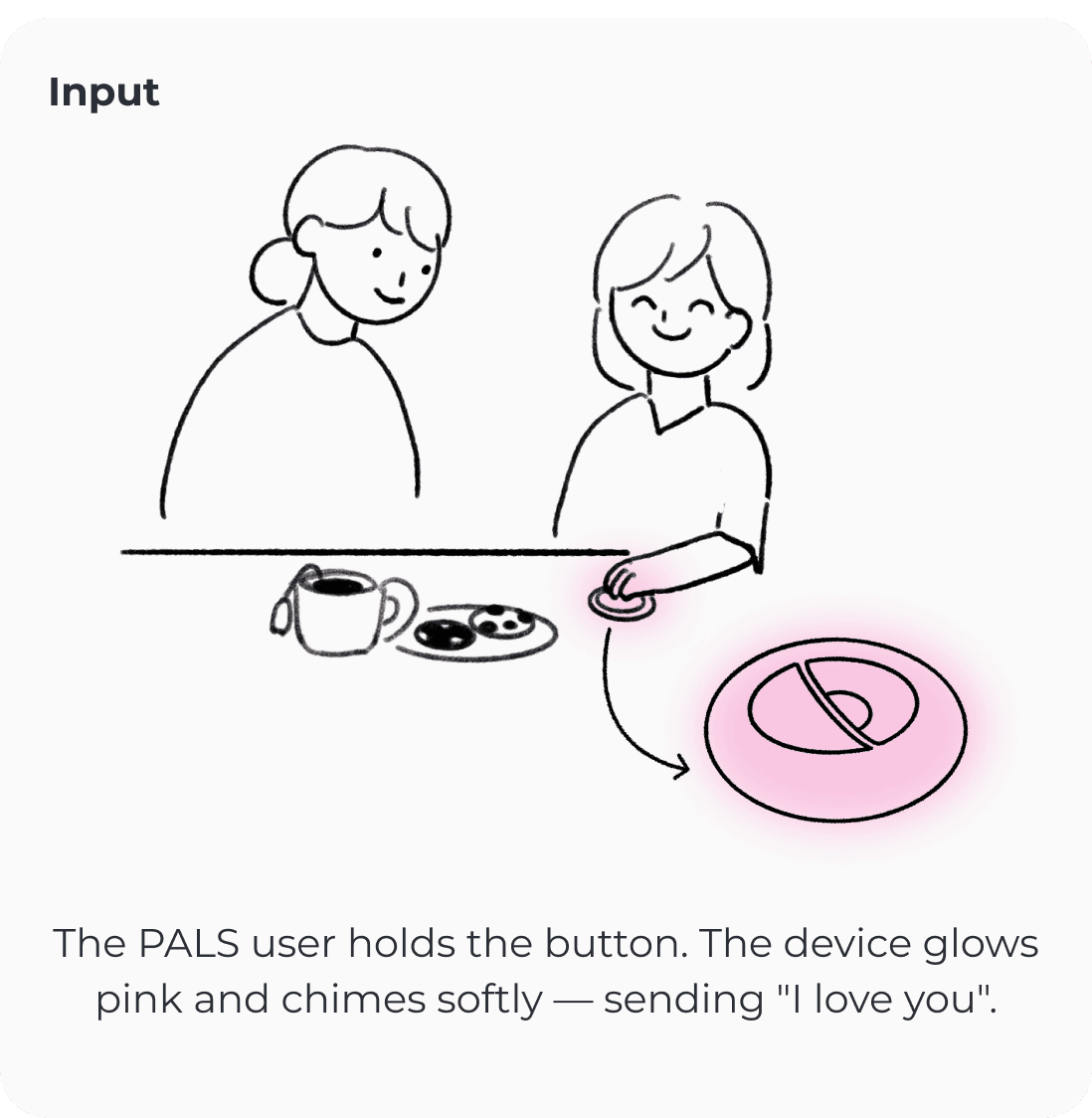
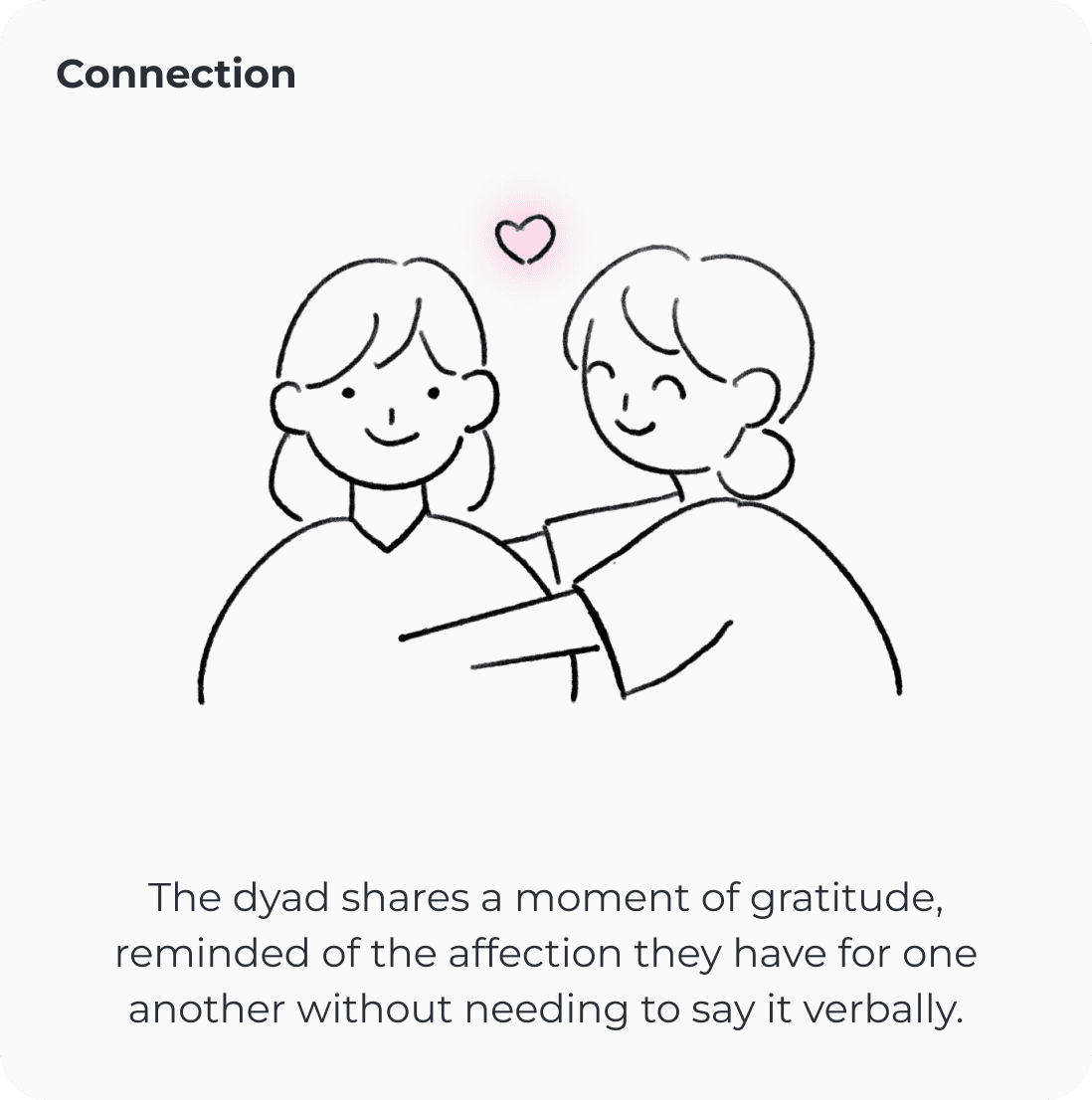
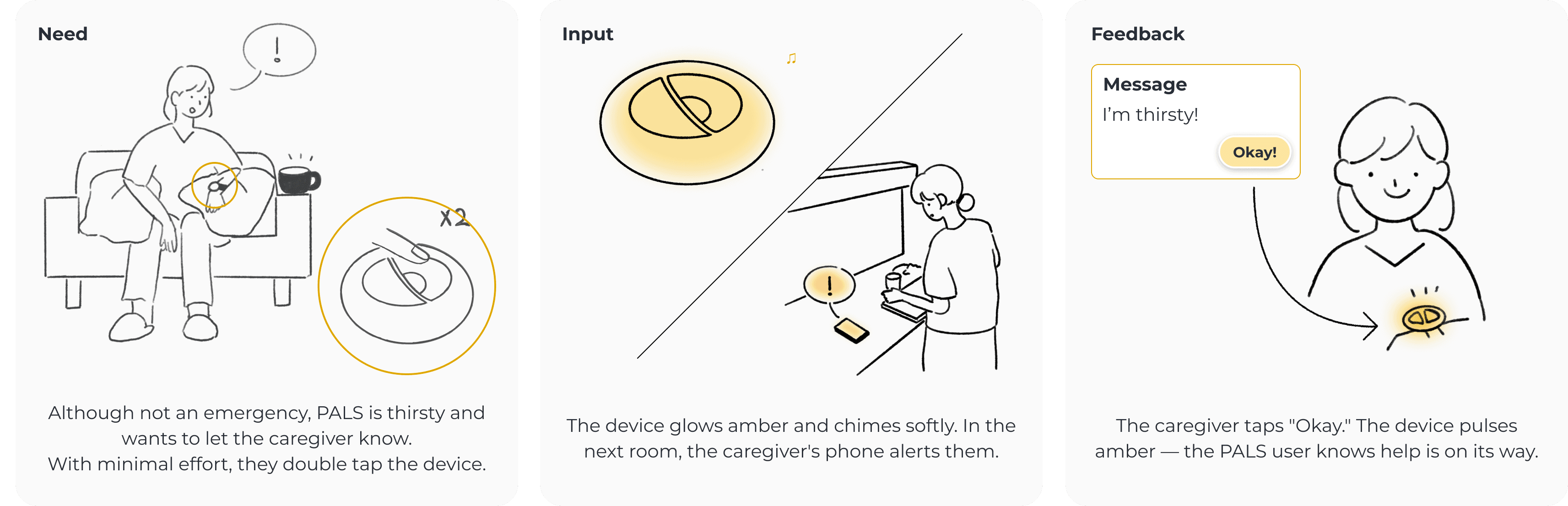
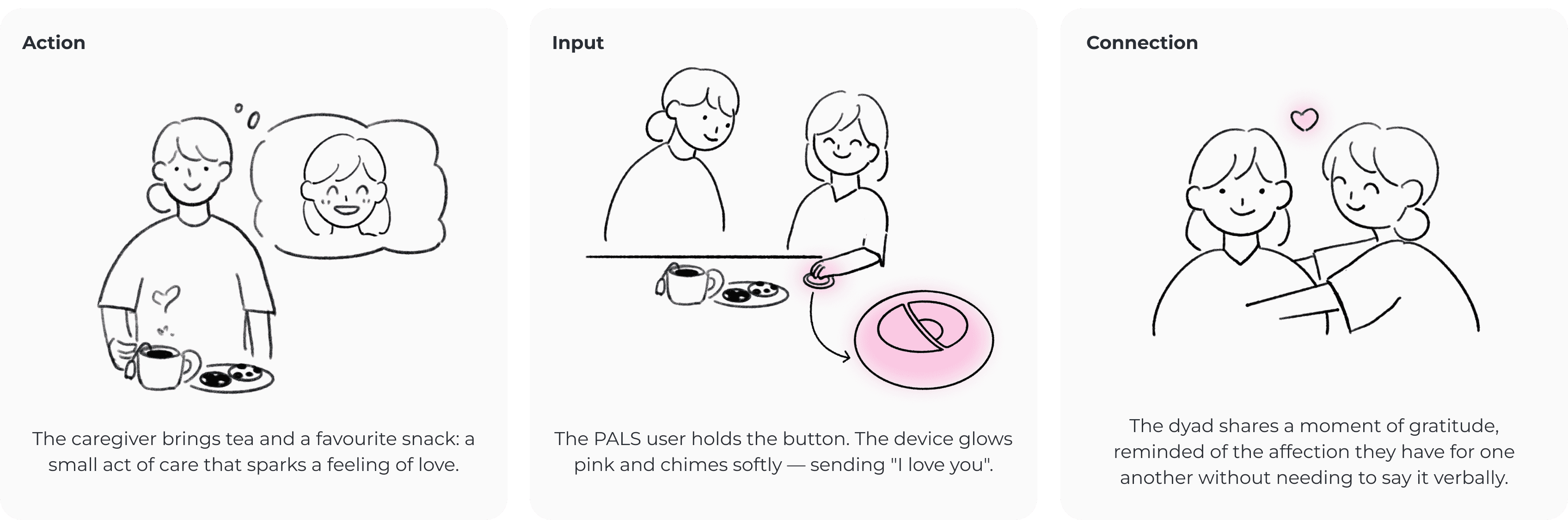
Staying connected while being independent, Communicating feelings without words
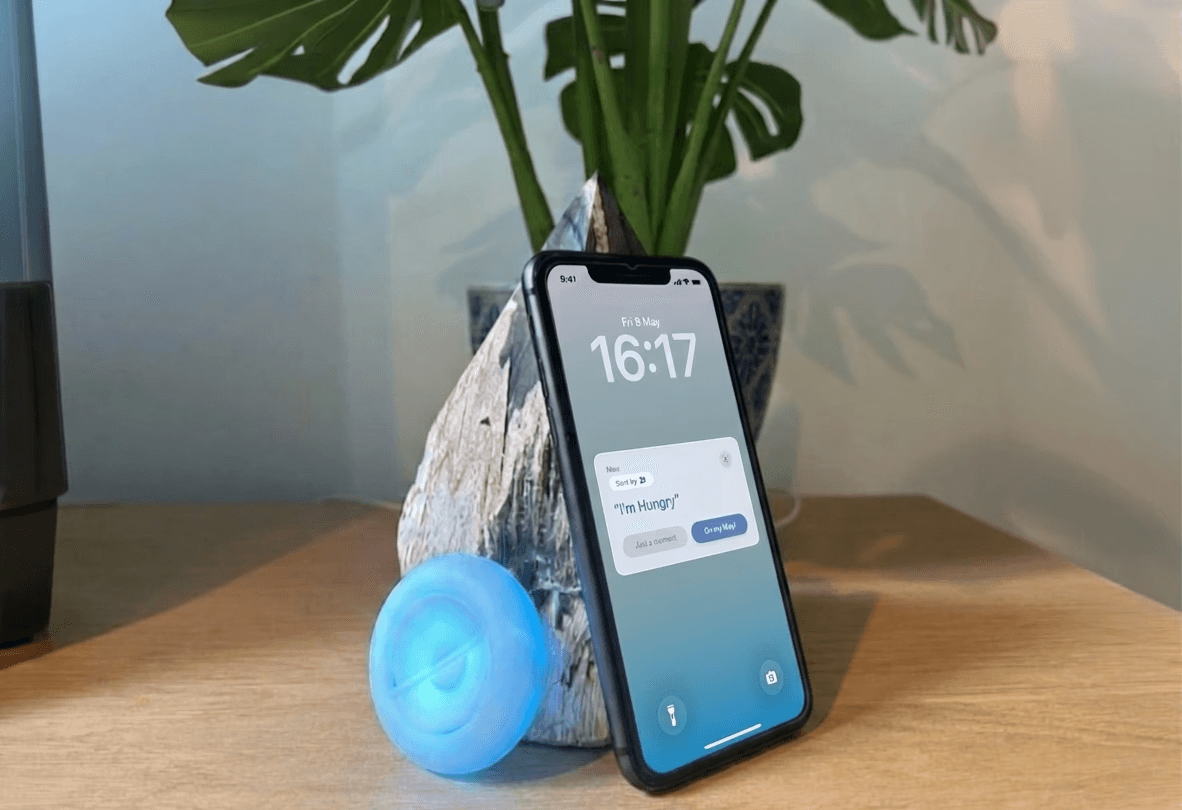
Messages are co-created by the dyad and mapped to their daily life. Caregivers receive notifications on their existing smartphone and can respond with a single tap — so the PALS knows they were heard.
Messages are co-created by the dyad and mapped to their daily life. Caregivers receive notifications on their existing smartphone and can respond with a single tap — so the PALS knows they
were heard.
Reflection
What does designing for your users truly mean?
This project challenged me to balance the complexities of a highly sentitive medical context. Due to strict ethical guidelines, direct contact with both PALS and caregivers was not possible. I supplemented this gap through my own autoethnographic data, extensive literature reviews and triangulating with other methodologies - case studies, testing.
While the ultimate validation of palm requires direct clinical testing with primary users, this constraint pushed me beyond traditional UX. Instead of simply mapping to an isolated user journey, I had to design for an entire ecosystem, accounting for how every layer—from the technical constraints of physical circuitry to materials, manufacturing, and care circles—directly shapes the end-user experience.
The financial demands of modern life have made dual-income households increasingly common. While this provides greater financial security, it can also lead to time constraints that affect the quality of parent-child relationships.

Palm
ROLE
UX Research & Design,
Physical Computing, Prototyping
THE DESIGN CHALLENGE
ALS rapidly takes away speech, fracturing daily life and isolating patients from those they love.
This project explores a low-effort experience designed to bridge this gap, preserving identity and connection without words.
DURATION
2025 - 2026
Graduate project
THEMES
Inclusive Design, Assistive Tech